Wakayama · Kumano Hongu Onsen (Yunomine & Kawayu)
Yunomine Onsen Public Bath (Ippan-yu, Kusuri-yu, Family Bath)
湯の峰温泉 公衆浴場(一般湯・くすり湯・家族湯)
The public bath at the heart of Yunomine Onsen, one of Japan's oldest springs, where pilgrims purified themselves before Kumano Hongū Taisha. The building, renovated in 2022, also serves as reception for the World Heritage 'Tsuboyu'. There are three bathrooms: the 'Ippan-yu' with hot and tepid tubs (adults ¥400, shampoo provided), the concentrated 'Kusuri-yu' filled with undiluted source water (¥600, no soap allowed) and a 30-minute private family bath (¥700), all sulphur-scented sodium-bicarbonate-chloride water ranging from milky to clear. Tsuboyu (¥800, 30-minute slots) can mean a wait of hours when busy, so the clever order is to take a number and warm up in the public bath first. Open 06:00–21:00 (last entry 20:30), irregular cleaning closures. The village also has the 'Yuzutsu', a 90 °C source where you boil eggs and vegetables, and is the trailhead of the Dainichi-goe section of the Kumano Kodō. About 2 hours by bus from JR Kii-Tanabe or Shingū stations to 'Yunomine Onsen', right by the stop; 46 parking spaces.
- Price (adult)
- ¥400
- Hours
- 06:00–21:00 (last entry 20:30)
- Closed
- Irregular (cleaning closures)
- Access
- Ryūjin bus toward Hongū Taisha from JR Kii-Tanabe Station, about 2 h to 'Yunomine Onsen', right by the stop; about 1 h 20 min by Kumano Gobō Nankai bus from JR Shingū Station; about 1 h 30 min by car from Kamitonda IC
- Water type
- Sulfur spring
- Tattoos
- Ask ahead
- Admission
- Ippan-yu (general bath) ¥400 for adults and ¥200 under 12 (shampoo and body soap provided); Kusuri-yu (medicine bath) ¥600/¥300, day pass ¥800/¥400 (no soap allowed); the family bath (30-minute private) ¥700/¥300; the World Heritage Tsuboyu (30-minute turns) ¥800/¥400 — Tsuboyu tickets include one bath in the Ippan-yu or Kusuri-yu. A 12-visit ticket book for the Ippan-yu costs ¥4,000. Drawing spring water is ¥100 for 10 litres. QR payments accepted
- Baths
- The public bathhouse at the centre of Yunomine Onsen, among the oldest hot springs in Japan, where pilgrims to Kumano Hongū Taisha performed their ritual purification. The building, renewed in 2022, also serves as the reception for the World Heritage Tsuboyu. There are three baths: the 'Ippan-yu' with separate rooms for men and women and two tubs (hot and lukewarm, shampoo provided); the rich 'Kusuri-yu', spring water left undiluted and cooled to bathing temperature (no soap allowed); and the 'family bath' for 30 minutes of private use. Right beside them is the Tsuboyu, full with two or three people. Outside, 90°C spring water wells up in the 'yuzutsu' tubes, where eggs and vegetables are boiled
- Spring water
- Yunomine Onsen, a sulphur-bearing sodium bicarbonate spring. The water runs from milky to clear with a clear sulphur scent and flakes of yu-no-hana drifting in it — a rich bath that warms you to the core. Because the Kusuri-yu uses the spring undiluted and simply cooled, its minerals are stronger than in the Ippan-yu, and the Tsuboyu is said to change colour seven times a day. Indicated for rheumatism, neuralgia, skin complaints, diabetes, poor circulation and fatigue
- Access & parking
- Ryūjin bus toward Hongū Taisha from JR Kii-Tanabe Station on the Kisei Line, about 2 hours to 'Yunomine Onsen', right by the stop; Kumano Gobō Nankai bus from JR Shingū Station, about 1 h 20 min. By car 1 h 30 min from Kamitonda IC on the Kisei Expressway, 1 h 40 min from Shirahama, 20 min from Kumano Hongū Taisha. Tourist parking for about 46 (some sections charged). The trailhead of the 'Ōnishi-goe' route of the Kumano Kodō
- Phone
- 0735-42-0074
- Official site
- hongu.jp ↗
- Open in Google Maps
- Google Maps ↗
Essentials
Find a stay on Trip.com
Search and book accommodation across Japan on Trip.com. Day-use bathing needs no booking.
Opens partner booking site (affiliate)
Why go
- Pilgrims' purification bath, among Japan's oldest
- Undiluted 'Kusuri-yu'; 30-min family bath
- Ippan-yu ¥400; soak while waiting for Tsuboyu
A pilgrims' purification bathhouse at one of Japan's oldest hot springs
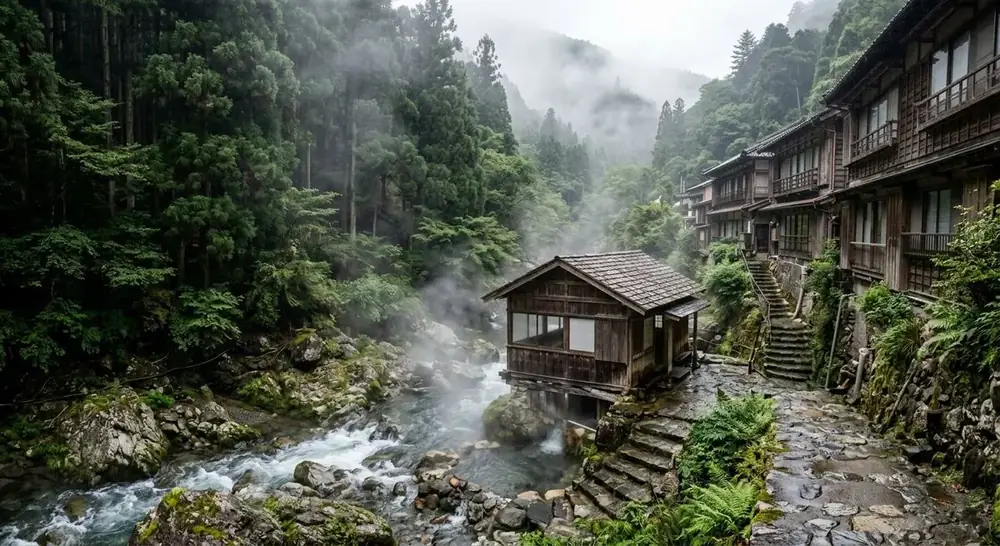
The Yunomine Onsen public bathhouse stands at the centre of the village of Yunomine, where roofs cluster along the floor of a narrow valley 20 to 30 minutes by car or bus from Kumano Hongū Taisha, in Tanabe, Wakayama. The spring is said to have some 1,800 years of history and was used as the place of 'yugori' — the ritual washing pilgrims performed before meeting the gods of the three Kumano shrines — making it among the oldest hot springs in Japan. The present building, renewed in April 2022, also serves as reception for the World Heritage Tsuboyu, and holds three baths of different character. The first is the Ippan-yu: separate for men and women, with a hot and a lukewarm tub and shampoo and body soap provided, so travellers can use it easily (¥400 for adults). The second is the Kusuri-yu: spring water left undiluted and simply cooled to bathing temperature, with stronger minerals than the Ippan-yu, a stronger sulphur scent and flakes of yu-no-hana drifting in the water. Soap is not allowed, so wash before entering; as the name — a bath for treatment and cure — suggests, it is a tub for a long soak and for setting the body to rights (¥600). The third is the family bath, private for 30 minutes, suiting those with children or who wish to avoid other eyes (¥700). And right beside the building is the symbol of the village and a World Heritage site, the Tsuboyu — a small tub for two or three made by boarding off a natural rock, on 30-minute turns, said to change colour seven times a day. It is popular and in high season the wait can run to hours, so the sensible order is to take a numbered tag at reception and warm up in the public bathhouse meanwhile (a Tsuboyu ticket includes one bath in the Ippan-yu or the Kusuri-yu). In the village, 90°C spring water wells up in the 'yuzutsu' tubes, where eggs and vegetables are boiled, and the onsen is the trailhead of the 'Ōnishi-goe' route of the Kumano Kodō.
The right order for Ippan-yu, Kusuri-yu, the family bath and Tsuboyu
Arriving in the village, first decide the aim of the day at the bathhouse reception. If the Tsuboyu is your aim, the standard order is: take a numbered tag at reception; bathe first in the Ippan-yu or the Kusuri-yu while you wait (included in the Tsuboyu fee); take your 30 minutes in the Tsuboyu when your number comes; and finish with an egg boiled in the yuzutsu. Queuing without a tag can mean hours of waiting in high season. The Ippan-yu has a hot and a lukewarm tub, so it works well to get used to the water in the lukewarm one, move to the hot one for 10 minutes, then rest again in the lukewarm one, and repeat. Shampoo and body soap are provided, so you can enter with no luggage — another good point of this bath. The Kusuri-yu uses undiluted spring water, so its minerals are strong and the sulphur scent is strong; soap is not allowed, so wash first and then go in for 20–30 minutes two or three times, which is the way of cure bathing. Afterwards drink plenty of water and rest about 30 minutes, and if your skin is sensitive start with the Ippan-yu to let the body get used to it. The family bath is private for 30 minutes, so with children it helps to plan the order of washing and soaking in advance. In the village's yuzutsu, 90°C spring water lets you boil eggs (about 13 minutes) and vegetables in a mesh bag, and there is a tap for drawing spring water at ¥100 for 10 litres. Notes: the Tsuboyu cannot be reserved and works by numbered tag; no soap in the Kusuri-yu; irregular closures (there are cleaning closure days — confirm on 0735-42-0074); last entry 20:30; buses are infrequent so check the last one; cash and QR payments accepted. At Yunomine you can wash as pilgrims did at one of Japan's oldest hot springs — a place not to be left out of a Kumano trip.
Practical details and a Kumano Kodō route
Hours are 6:00–21:00 (last entry 20:30), closures irregular (there are cleaning closure days); the Ippan-yu ¥400, the Kusuri-yu ¥600, the family bath ¥700 and the Tsuboyu ¥800 (roughly half for under 12s), with a 12-visit ticket book for the Ippan-yu at ¥4,000. Drawing spring water is ¥100 for 10 litres. Parking is the village tourist car park of about 46 spaces. Access is 2 hours by bus from Kii-Tanabe Station, 1 h 20 min from Shingū Station, and 1 h 30 min by car from Kamitonda IC. Suggested routes: (1) a day at Kumano Hongū — the great shrine and Ōyunohara, then bus or car to Yunomine for the public bathhouse and the Tsuboyu, then a walk on the Ōnishi-goe or an egg in the yuzutsu; (2) walking the Kumano Kodō — Takijiri-oji, Tsugizakura-oji, a night in Yunomine (Tsuboyu and public bathhouse), then over the Ōnishi-goe from Yunomine to Hongū; (3) centred on the Tsuboyu — the public bathhouse at 6 a.m., a numbered tag for the Tsuboyu, the Kusuri-yu while waiting, 30 minutes in the Tsuboyu, then on to Hongū; (4) paired with Shirahama — a night at Shirahama Onsen (Saki-no-yu, Muro-no-yu) and a night at Yunomine to compare two hot springs; (5) a cure stay — two or three nights at a Yunomine inn with the Kusuri-yu, the Tsuboyu and walks each day. Notes: the Tsuboyu is by numbered tag and cannot be reserved; no soap in the Kusuri-yu; check the irregular closures; check the last bus (they are infrequent); parts of the village parking are charged; cash and QR payments accepted. Yunomine Onsen has been a place of washing on the Kumano pilgrimage road for 1,800 years, and with the World Heritage Tsuboyu it offers a meeting with the original form of the Japanese onsen.
Before you go
- No official tattoo policy is published — ask at reception.
- The water runs hot (43–45°C). Don't add cold water; take short repeated dips instead.
- Payment is usually by ticket machine in cash — bring coins.
- Last entry is 30–60 minutes before closing.
Features
Mood & scenery
Rules & private
Price
Who with
Convenience
Amenities
✔ Verified operating: 2026-09 Operating status and rates cross-checked against the official site and onsen guides (full source notes in Japanese on the JA page)
Prices and hours change. Check official sources before visiting.
More in this area

Saki-no-Yu
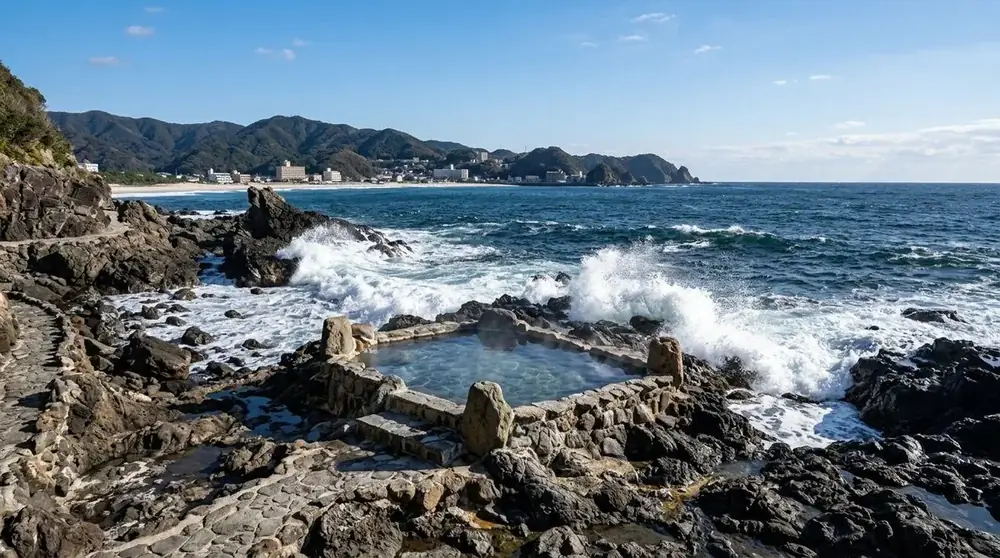
An open-air-only bath at the edge of the Pacific. One of Japan's oldest springs, mentioned in the 8th-century Nihon Shoki; on rough days sea spray reaches the tubs. No roof, no wash stations.

Shirahama Onsen Muro-no-yu
Shirahama's other classic public bath, on the Yuzaki seafront near Saki-no-yu. Its draw: two distinct springs — Mabuyu and Miyukiyu — under one roof. 7 am to 10 pm, ¥420.

Ryujin Onsen Motoyu
The source bath of Ryujin Onsen, counted with Yunokawa and Kawanaka among Japan's 'three beauty baths'. It stands on the Hidaka River deep in the Kii mountains, with a cypress indoor bath and a rock rotenburo overlooking the stream. The silky bicarbonate water is famous for leaving skin smooth. ¥800, 7:00–21:00, open daily. An hour by car from Koyasan via the Koya-Ryujin Skyline, or about 80 minutes by bus from Kii-Tanabe.