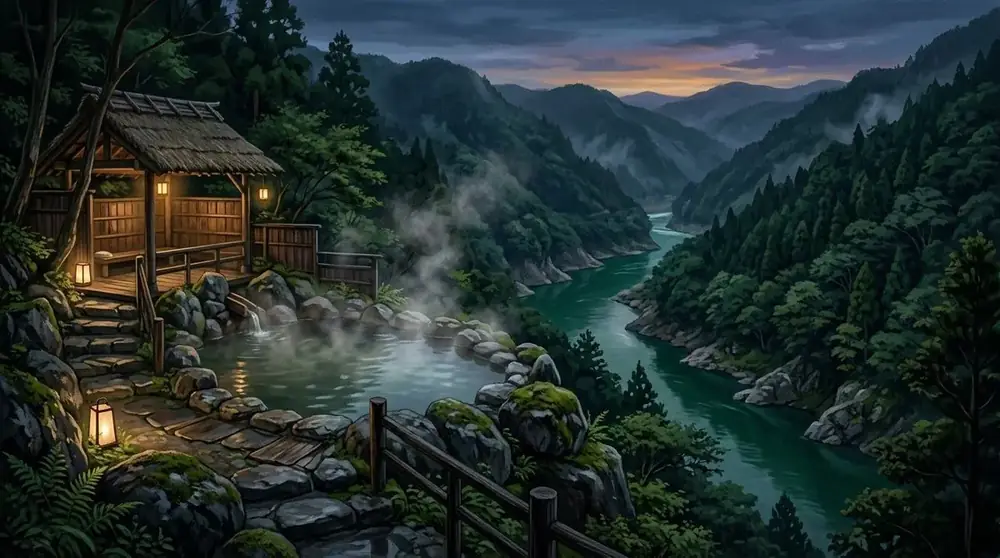
Wakayama · Kumano Hongu Onsen (Yunomine & Kawayu)
Yunomine Onsen Tsuboyu
湯の峰温泉 つぼ湯
The only hot spring inscribed as a World Heritage Site that you can actually bathe in, listed together with the Kumano Kodo pilgrimage routes. A tiny hut over the stream in Yunomine — said to be Japan's oldest onsen at 1,800 years — shelters a tub hollowed from natural rock that fits two adults. The sulfurous water is said to change colour seven times a day and served pilgrims for ritual purification. Private 30-minute slots, ¥800, sign up at the public bathhouse (6:00–21:00). Waits of several hours are common on holidays; boil onsen eggs in the hot-spring trough while you wait.
- Price (adult)
- ¥800
- Hours
- 6:00–21:30 (register at the public bathhouse; 30 min per party, no reservations)
- Closed
- Irregular (closed for cleaning or when the river is high)
- Access
- About 100 min by Ryujin Bus from JR Kii-Tanabe Station to Yunomine Onsen, then 1 min on foot; about 70 min by bus from JR Shingu; 10 min by car from Kumano Hongu Taisha
- Water type
- Sulfur spring
- Tattoos
- Ask ahead
- Admission
- Adults ¥800, under 12 ¥400 (one group per 30 minutes, up to 2–3 people together). Take a number at the public bathhouse counter and buy a ticket from the machine; no reservations, first come first served, and waits of 1–2 hours are common at weekends. Tsuboyu bathers may also enter either the 'general bath' (worth ¥400) or the 'medicinal bath' (worth ¥600) of the public bathhouse once the same day. No shampoo or soap (prohibited to protect the spring); bring a towel
- Baths
- In the middle of the Yunomine onsen village, inside a tiny board hut built over the Yunotani stream, sits a single tub hewn from natural rock for 2–3 people. The source wells up directly through the floor and is said to change colour seven times a day (clear, milky white, bluish); at 92°C you cool it yourself with a cold-water hose. Wait your turn in the shelter. Right next door are the Yunomine public bathhouse (rebuilt 2022: general, medicinal and family baths) and the 92°C 'yuzutsu' cooking pool where locals boil eggs and sweet potatoes (spring water ¥100 per 10 L). Listed as World Heritage in 2004 — the only World Heritage site in the world you can bathe in
- Spring water
- Sulphur-bearing sodium bicarbonate spring (weakly alkaline), 92°C at source, about 150 L/min. A distinct sulphur scent and bubbles rising from the floor as the colour shifts through the day — a mysterious bath. Tsuboyu is 100% free-flowing source water (cooled by adding cold water). Indicated for skin disease, rheumatism, neuralgia and diabetes. Yunomine, opened some 1,800 years ago, is counted among Japan's oldest springs and was the 'yugori' purification site for medieval Kumano pilgrims; the legend of Oguri Hangan tells of him being cured in this very tub
- Access & parking
- 10 minutes (4 km) by car from Kumano Hongu Taisha, or about 1 hour on foot over the steep 'Dainichi-goe' section of the Kumano Kodo (3.4 km). By bus about 2 hours on the Ryujin bus from JR Kii-Tanabe to 'Yunomine Onsen', about 1 h 10 min from JR Shingu, or 10 minutes from Hongu Taisha-mae. Free public car park at the village entrance, then walk. From Osaka or Kyoto, about 2.5 hours to Kii-Tanabe on the Kuroshio limited express
- Phone
- 0735-42-0074
- Official site
- hongu.jp ↗
- Open in Google Maps
- Google Maps ↗
Essentials
Find a stay on Trip.com
Search and book accommodation across Japan on Trip.com. Day-use bathing needs no booking.
Opens partner booking site (affiliate)
Why go
- The only bathable World Heritage onsen
- Rock-hewn tub for two
- 30-minute private slots, ¥800
The only World Heritage site on earth you can bathe in
Yunomine Onsen's Tsuboyu is a rock tub at the heart of Yunomine, a tiny hot-spring hamlet one ridge away from Kumano Hongu Taisha in Hongu, Tanabe, Wakayama. Opened some 1,800 years ago and counted among Japan's oldest springs, Yunomine was from medieval times the 'yugori' site where Kumano pilgrims purified themselves before worshipping at Hongu; that history earned it UNESCO World Heritage listing in 2004 as part of the 'Sacred Sites and Pilgrimage Routes in the Kii Mountain Range'. Of all World Heritage hot springs, it is the only one on earth you can actually bathe in. Tsuboyu is a tub for two or three hewn from natural rock inside a small board hut over the Yunotani stream; the 92°C source rises straight through the floor and is said to change colour seven times a day. Bathing is private, one party per 30 minutes, so you take a number at the public bathhouse counter and wait; the ¥800 fee includes one entry to that bathhouse. With the legend of Oguri Hangan brought back to life here and eggs boiled in the 'yuzutsu' cooking pool, it is a highlight of any Kumano Kodo journey.
Take a number, cool the 92°C source and climb in
First register for Tsuboyu at the public bathhouse counter and receive a number and ticket. There are no reservations and it is strictly first come, so waits of 1–2 hours are normal on Saturday afternoons and holidays; if your number is called and you are absent you lose your turn, so stay near the riverside shelter (boil eggs in the yuzutsu or use the public bath first while you wait). When the previous party leaves, hang your number by the door and lock it from inside. Inside is just one rock tub where two or three sit knee to knee, plus a space to undress; the water rising from the floor is scalding, so add cold water from the hose and set the temperature yourself before getting in. Sulphur hangs in the air, bubbles rise, and depending on the hour the water may be clear, milky or bluish — catching one of its 'seven colours a day' is the delight. Soap and shampoo are banned and you must be out within 30 minutes, so focus on the experience of soaking in a World Heritage site rather than a leisurely wash. Afterwards, wash properly in the public bathhouse rebuilt in 2022, in the general bath (shampoo provided) or the more concentrated medicinal bath (no soap). In winter and on rainy days a swollen river can close Tsuboyu, so check with the tourist association on the day.
Combining Yunomine with the Kumano Kodo
Tsuboyu is open 6:00–21:30 (register at the public bathhouse), with irregular closures; adults ¥800, under 12 ¥400, including one entry to the public bathhouse (older sources quote ¥750–780). Yunomine is a small hamlet of a dozen inns and guesthouses, and the great advantage of staying is walking in without a wait right after the 6 a.m. opening; day visitors find early morning or dinnertime quietest. The best route: worship at Kumano Hongu Taisha and the great torii at Oyunohara, cross to Yunomine on foot over the Kumano Kodo's steep 'Dainichi-goe' (about an hour), bathe in Tsuboyu, boil an egg in the yuzutsu, then continue by bus to Kawayu Onsen (the riverbed Sennin-buro in winter) or Watarase Onsen (large rotenburo) to complete the 'three baths of Hongu'. All three lie on the Ryujin bus route 10–15 minutes from Hongu Taisha-mae, but buses from Kii-Tanabe and Shingu run only a few times a day, so check timetables. At 1,800-year-old Yunomine the authentic 'yugori' order is to bathe in Tsuboyu before worshipping at Hongu — so the most traditional plan is to stay a night, soak at dawn and walk the old road to the shrine.
Before you go
- No official tattoo policy is published — ask at reception.
- Payment is usually by ticket machine in cash — bring coins.
- Last entry is 30–60 minutes before closing.
Features
Rules & private
Mood & scenery
Price
Who with
Convenience
Only here
Amenities
✔ Verified operating: 2026-09 Operating status and rates cross-checked against the official site and onsen guides (full source notes in Japanese on the JA page)
Prices and hours change. Check official sources before visiting.
More in this area

Saki-no-Yu
An open-air-only bath at the edge of the Pacific. One of Japan's oldest springs, mentioned in the 8th-century Nihon Shoki; on rough days sea spray reaches the tubs. No roof, no wash stations.

Shirahama Onsen Muro-no-yu
Shirahama's other classic public bath, on the Yuzaki seafront near Saki-no-yu. Its draw: two distinct springs — Mabuyu and Miyukiyu — under one roof. 7 am to 10 pm, ¥420.

Ryujin Onsen Motoyu
The source bath of Ryujin Onsen, counted with Yunokawa and Kawanaka among Japan's 'three beauty baths'. It stands on the Hidaka River deep in the Kii mountains, with a cypress indoor bath and a rock rotenburo overlooking the stream. The silky bicarbonate water is famous for leaving skin smooth. ¥800, 7:00–21:00, open daily. An hour by car from Koyasan via the Koya-Ryujin Skyline, or about 80 minutes by bus from Kii-Tanabe.