Akita · Nyūtō Onsen
Tsurunoyu Onsen
鶴の湯温泉
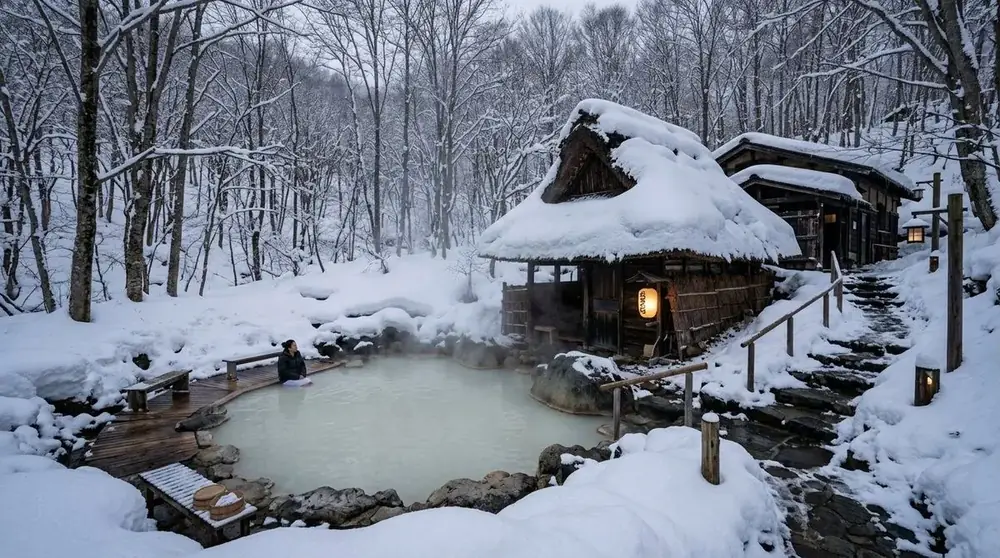
The oldest inn in the Nyuto Onsen area, a hidden hot spring dating to the Edo period. The thatched 'Honjin' building and the large milky-white mixed rotenburo are its iconic scene. Day bathing 10:00–15:00; on Mondays the rotenburo is closed for cleaning and only indoor baths are open. Rooms sell out months ahead. From Tazawako Station take the bus, then the inn shuttle from Alpa Komakusa.
- Price (adult)
- ¥700
- Hours
- day use 10:00–15:00
- Closed
- Open daily (Mon indoor baths only while the rotenburo is cleaned; next day if holiday)
- Access
- Bus from JR Tazawako + inn shuttle
- Water type
- Sulfur spring
- Tattoos
- Ask ahead
- Spring types (4 sources)
- Shiro-yu (Na-chloride-bicarbonate, hydrogen-sulphide type, 59.6°C, pH 6.6 — feeds the mixed rotenburo) / Kuro-yu (sulphur-Na-chloride-bicarbonate, 58.7°C) / Naka-no-yu (sulphur-Na·Ca-chloride-bicarbonate, 45.1°C) / Taki-no-yu (cascade bath, 51.7°C). All bluish milky-white, free-flowing, no heating, no chlorine
- Baths open to day visitors
- The large mixed rotenburo (water rising through the gravel floor; open in winter too), a women-only rotenburo, separate indoor Shiro-yu, Kuro-yu and Naka-no-yu, and the Taki-no-yu cascade. Mondays (next day if holiday) indoor baths only while the rotenburo is cleaned. Private baths are for overnight guests
- Price
- Adults ¥700, elementary ¥300, preschoolers (3+) ¥100. Cash only. Towels sold. Seating only for rest; meals such as the yam hotpot set at the annex 'Yama no Yado'
- Phone
- 0187-46-2139
- Official site
- www.tsurunoyu.com ↗
- Open in Google Maps
- Google Maps ↗
Essentials
Stay in this onsen town
Compare and book stays in Nyūtō Onsen. Day bathing itself needs no booking.
Opens partner booking site (affiliate)
Why go
- Edo-period hidden spring
- Milky mixed open-air bath
- Day use 10:00–15:00
History and setting
The oldest of the seven Nyūtō springs: records show the Akita lord Satake Yoshitaka coming to take the waters in the Kan'ei era (1624–44), and an inn was operating here by 1661. The name comes from a legend of a hunter who saw a wounded crane (tsuru) healing itself in the spring. The thatched long-house 'Honjin', once quarters for the lord's guards, is still used as guest rooms with sunken hearths. Bath huts are scattered along a stream in primeval beech forest, and in winter the sight of thatched roofs under two or three metres of snow beside the milky open-air pool has become the defining image of a Japanese 'hidden hot spring'. A member of the Japan Association of Secluded Hot Springs, it is often booked out months ahead for overnight stays, but day bathing is accepted 10:00–15:00 and includes almost every bath, the big mixed rotenburo among them.
How to bathe here & practical notes
- The baths are in several separate huts, each indoor bath (Shiro-yu, Kuro-yu, Naka-no-yu) with its own changing room — women change three times and men twice to try them all, so allow plenty of time.
- No bathing garments, swimwear or wrapped towels in the mixed rotenburo. Women can, however, slip in directly from the Naka-no-yu bathhouse along the rocks, and the milky water hides the body, making it manageable even for first-timers. If mixed bathing is not for you, use the women-only rotenburo.
- Washing facilities are rudimentary with almost no showers; no soap, shampoo or hair dryers. Bring a towel (also sold).
- In the rotenburo the water rises through the gravel floor, so the temperature varies — hot near the source, cooler at the edges.
- Sulphur tarnishes silver and the smell lingers after bathing. Take breaks; long soaks bring on light-headedness.
- No explicit tattoo ban is posted (be discreet, as is customary at secluded inns).
- Cash only, and mobile phones often have no signal. From late November to April the road is icy and snowbound — winter tyres are essential, or take the shuttle bus.
- Day bathing is 10:00–15:00 only; no entry after check-in time or in the morning. In autumn-leaf season and on winter weekends it is busiest around midday, so aim for the 10 am opening.
Access and touring the Nyūtō springs
From Tazawako Station (Akita Shinkansen) take the Ugo Kōtsū Nyūtō-line bus about 35 minutes to Alpa Komakusa, then change to Tsurunoyu's own shuttle for the final 10 minutes (day visitors welcome; call ahead). From the 'Tsurunoyu Onsen Iriguchi' stop it is a 3 km unpaved walk of about 35 minutes — not realistic in winter. By car it is about 40 minutes from Tazawako Station or 1.5 hours from Morioka IC; parking is free. The Nyūtō group comprises seven inns — Tsurunoyu, Taenoyu, Kuroyu, Ganiba, Magoroku, Ōgama and Kyūkamura — and overnight guests can buy a 'Yumeguri-chō' pass (¥2,500, valid one year) covering all of them. On a day trip the classic pairing is Tsurunoyu plus Kuroyu (10:00–16:00, closed in winter) or Taenoyu (10:00–15:00, closed Tuesdays).
Before you go
- No official tattoo policy is published — ask at reception.
- There is a mixed-gender area. Check the description for bathing garments and women-only hours.
- Ryokan day-use hours are limited and may be suspended in peak season — phone the same morning.
- Payment is usually by ticket machine in cash — bring coins.
- Last entry is 30–60 minutes before closing.
Features
Mood & scenery
✔ Verified operating: 2026-09 公式・現地掲示 (日帰り大人700円/小学生300円, 10:00–15:00, 月曜は内湯のみ)
Prices and hours change. Check official sources before visiting.
More in this area
Kuroyu Onsen (Nyūtō)
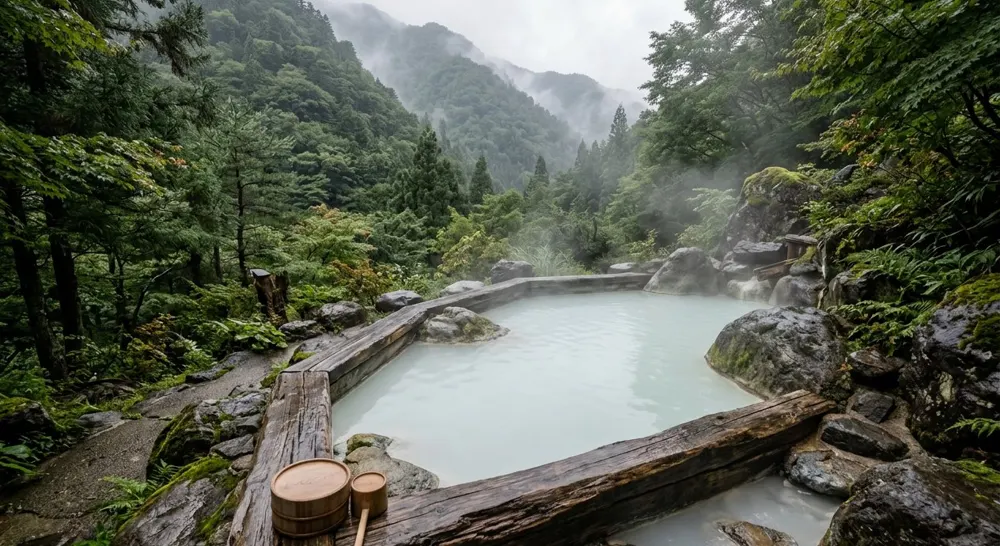
The innermost of Nyūtō's seven baths — a cluster of thatched bath huts. Two separate sources feed a mixed open-air pool and gender-separated indoor/outdoor baths of milky sulfur water. Day use 9 am–4 pm, the longest window of the seven; closed mid-November to mid-April.
Nyūtō Onsen Tae-no-yu
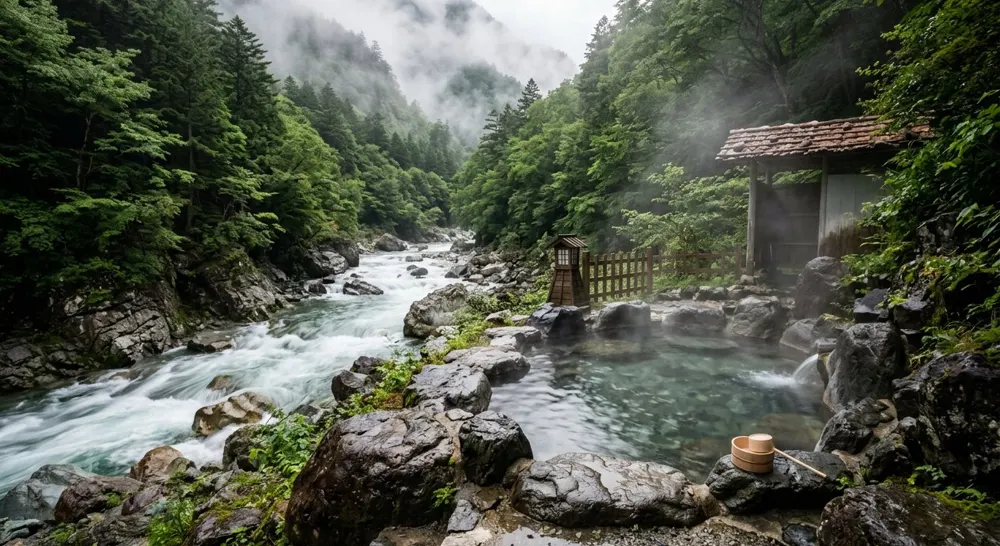
The most polished of the seven Nyūtō inns, beside the Sendatsu stream and popular with women. Two sources — rusty 'gold' and clear 'silver' — in open-air baths above the rushing river. Day-use reception is short (10:30 am–2 pm), so come early.
Shin-Tamagawa Onsen
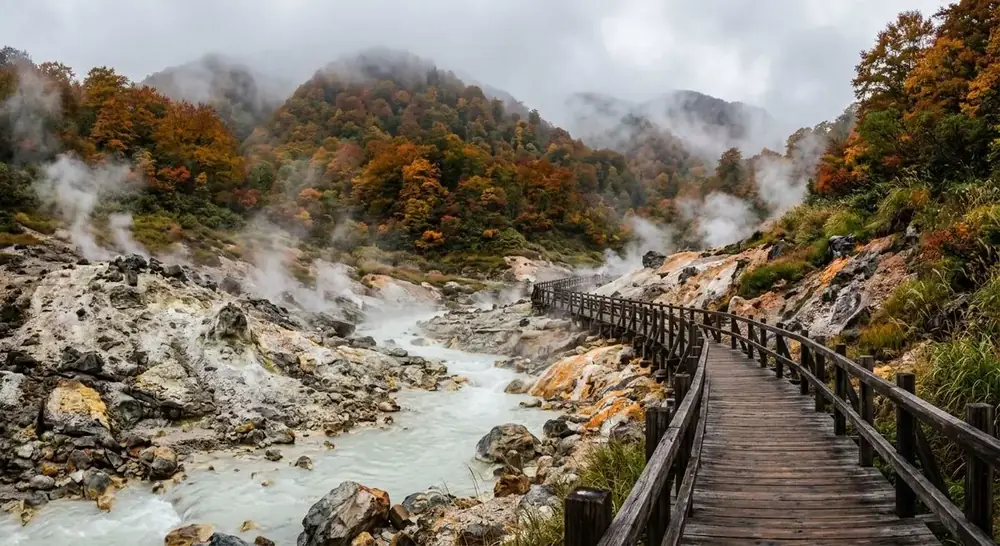
A modern cure-bath inn fed by Tamagawa Onsen, Japan's most acidic spring at pH 1.2. The hiba-cypress bathhouse lines up 15 tubs — 100% source, 50% diluted, mildly acidic and more — so you can choose by condition. Day use 10:00–15:00, ¥1,000 (revised April 2026). An indoor stone-slab bath (¥800) is also available, and unlike the original Tamagawa it stays open all winter for snowbound soaking. About 70 min by bus from Tazawako Station.