Tottori · Sekigane Onsen
Sekigane Onsen Yūmeikan
関金温泉 せきがね湯命館
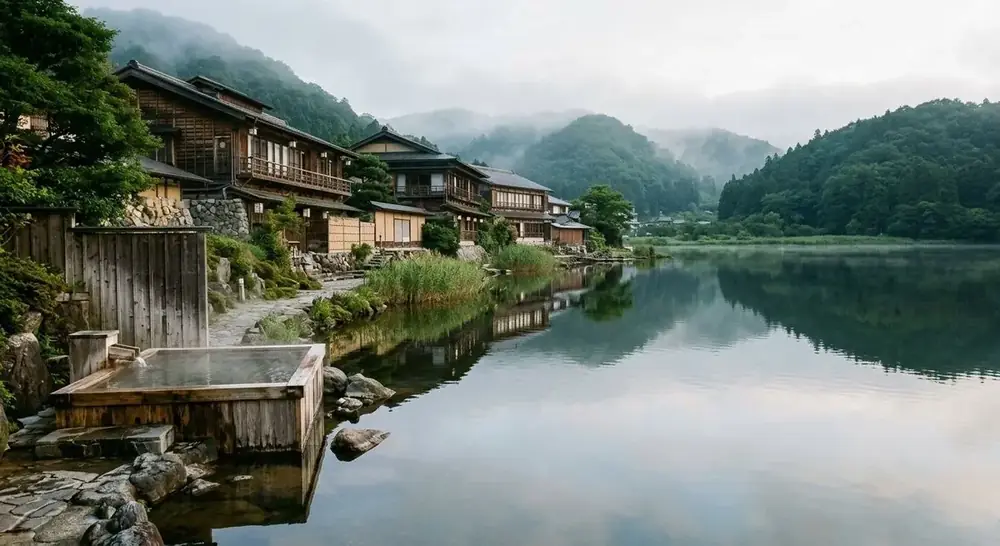
A day bathing facility at Sekigane Onsen, a 1,300-year-old spa in the hills of Kurayoshi near the Tottori–Okayama border. Once known as the 'platinum bath', its clear radium (radioactive) spring is said to be among the richest in Japan and leaves skin soft. Men's and women's indoor and open-air areas offer eight kinds of tubs, and the outdoor bath looks across ridges running toward Mt. Daisen. Adults pay ¥820, elementary pupils ¥410 and small children enter free. Open 10:00–21:00 (last entry 20:30), closed Mondays (next day if a holiday). On site are the Shirogane dining room using local produce, a free tatami hall, paid private rooms (¥1,580 for two hours), massage and beauty treatments, and free parking for 100 cars. From JR Kurayoshi Station take the Sekigane-bound bus about 35 minutes to Sekigane Onsen and walk 5 minutes, or drive about 40 minutes from Yubara IC on the Yonago Expressway via Route 313. Pair it with the cliff temple Nageiredō on Mt. Mitoku, Kurayoshi's white-walled storehouses or the Hiruzen highlands.
- Price (adult)
- ¥820
- Hours
- 10:00–21:00
- Closed
- Mondays (next day if a holiday)
- Access
- Hinomaru bus toward Sekigane from JR Kurayoshi Station about 35 min to 'Sekigane Onsen', then 5 min on foot; about 40 min by car from Yubara IC (Yonago Expressway) via Route 313; about 25 min by car from central Kurayoshi
- Water type
- Radon spring
- Tattoos
- Ask ahead
- Admission
- Bathing adults (junior high and up) ¥820, elementary ¥410, infants free. Kurayoshi residents pay ¥510/¥260 on showing proof. Face towels ¥160 to buy, bath towels ¥200 to rent, shampoo and body soap free, lockers with keys free, a private rest room ¥1,580 for two hours (¥530 per extra hour). Restaurant 'Shirogane Shokudō', a shop, bodywork and esthetic. Cash
- Baths
- A day-use bathing facility in Sekigane, Kurayoshi, in the folds of the Chūgoku mountains near the Tottori–Okayama border. The colourless, transparent radium spring long called 'the platinum bath' is enjoyed across eight kinds of tub in the separate men's and women's indoor and outdoor baths, and two bathhouses — a rock-bath type and a wood-bath type — swap between men and women each week. From the rotenburo you look over ranges running toward Mt. Daisen, and with a free large hall, paid private rooms, a restaurant and bodywork and esthetic it is a facility for a whole day
- Spring water
- The colourless, transparent simple radioactive spring (hypotonic, weakly alkaline) of Sekigane Onsen, said to have been opened 1,300 years ago — a radium spring. It is held to have one of the highest radon contents in Japan and has long been called 'the platinum bath'; many say the skin turns moist and the body feels light afterwards. Indicated for gout, arteriosclerosis, high blood pressure, chronic skin complaints and more
- Access & parking
- Nihon Kōtsū bus (for Sekigane Bus Center via Sekigane Onsen) from JR Kurayoshi Station, about 35 minutes to 'Sekigane Onsen', then 5 minutes on foot. By car 27 km and about 40 minutes from Yubara IC on the Yonago Expressway via Route 313, or about 30 minutes via Ochiai JCT on the Chūgoku Expressway, about an hour and a half from Okayama city, an hour from Tottori city. Free parking for 100
- Phone
- 0858-45-2000
- Official site
- yumeikan.jp ↗
- Open in Google Maps
- Google Maps ↗
Essentials
Find a stay on Trip.com
Search and book accommodation across Japan on Trip.com. Day-use bathing needs no booking.
Opens partner booking site (affiliate)
Why go
- Radium 'platinum' spring, among Japan's richest
- Eight tubs indoors and out with Daisen-side views
- ¥820; closed Mon; 35 min by bus from Kurayoshi
A 1,300-year-old radium spring across eight tubs
Sekigane Yūmeikan is a day-use bathing facility in Sekigane, Kurayoshi, Tottori, standing in a mountain hollow of the Chūgoku range near the border with Okayama. Sekigane Onsen is a spa said to have been opened 1,300 years ago, and its colourless, transparent water earned it the name 'the platinum bath' long ago. The water is a simple radioactive spring (hypotonic, weakly alkaline) — a radium spring — held to have one of the highest radon contents in Japan, and people come for the way the skin turns moist and the body feels light afterwards, some for gout, arteriosclerosis or high blood pressure. The baths come in two kinds, a rock-bath type and a wood-bath type, and they swap between men and women each week, so seeing one side does not reveal the whole facility. Between them there are eight kinds of tub — a pounding-water bath, a bubble bath, a lukewarm tub, a lying-down tub, a plunge, a sauna and a large rotenburo — and the calm, wood-scented bathhouse and the dramatic rock bathhouse are clearly different in atmosphere, so many people visit twice. From the rotenburo you look over ranges running toward Mt. Daisen, and in winter the snow-covered Chūgoku mountains are especially fine. The side facilities are substantial too: a free large hall for resting, paid private rooms (¥1,580 for two hours, ¥530 per extra hour) that suit families and groups, and recovery equipment such as bodywork, esthetic, a hyperbaric oxygen capsule and an organic germanium bath. The restaurant 'Shirogane Shokudō' serves dishes of local ingredients, so bathing and eating can be done in one place. Rates are ¥820 for adults and ¥410 for elementary pupils (¥510/¥260 for Kurayoshi residents), hours 10 a.m. to 9 p.m. (last entry 8:30 p.m.), closed Mondays (the next day if a holiday). With Mitokusan's Nageire-dō, the white-walled storehouse streets of Kurayoshi and the Hiruzen highlands nearby, it is a convenient base for touring San'in and the Chūgoku mountains.
Circuiting two bathhouses, with meals and rest
Enter from the free car park (100 spaces) and pay (¥820). Shampoo and body soap are free and lockers with keys are free; face towels cost ¥160 to buy and bath towels ¥200 to rent. A recommended circuit: wash and soak 10 minutes in the main tub; take the lukewarm tub at length — with a radium spring it is better to stay in gently and long; let the pounding water work on your shoulders; 15 minutes in the bubble bath and the lying-down tub; 8–10 minutes in the sauna and a minute in the plunge; then 15 minutes in the large rotenburo looking at the ranges. The heart of this facility is its two bathhouses: the rock-bath type and the wood-bath type swap between men and women each week, so if the rock bath is your side today it will be the wood bath next time. The atmospheres are utterly different, which is why many come twice; on a first visit ask at the desk which side is the men's today. Afterwards rest in the free large hall, or, for families and groups, hire a private room (¥1,580 for two hours) and lie down. On days when the body feels heavy add bodywork, esthetic or the hyperbaric oxygen capsule, and eat a meal of local ingredients in 'Shirogane Shokudō' to fill the day. Notes: closed Mondays (the next day if a holiday); last entry 20:30; towels charged separately; weekend afternoons are crowded; bring cash. Note that Tottori's official tourism site lists 10:00–22:00 (until 21:00 in winter from 7 January to 28 February) and closures on the second and fourth Mondays, so if you plan a late visit or one around a Monday, confirming by phone is the safe move.
Practical details and a San'in and Chūgoku mountains route
Hours are 10:00–21:00 (last entry 20:30), closed Mondays (the next day if a holiday); adults ¥820, elementary ¥410, infants free (Kurayoshi residents ¥510/¥260), private rooms ¥1,580 for two hours, free parking for 100. Access is 35 minutes by bus from Kurayoshi Station plus 5 minutes on foot, or 40 minutes from Yubara IC. Suggested routes: (1) a bath round of Sekigane — Yūmeikan, then the old spa-town baths such as Seki-no-Yu communal bath (¥200) and Yurari (¥400), finishing at the free footbath of Enmei-chaya; (2) a day in Kurayoshi — the white-walled storehouses and red tiles, a bath at Yūmeikan, then Kurayoshi Station; (3) Mitokusan — a visit to the Nageire-dō (there is a mountain path), recovery at Yūmeikan, then Yubara Onsen; (4) Hiruzen — the Hiruzen highlands (dairy farm, soba), Yūmeikan, then Yonago; (5) a two-stop bath day — Yūmeikan at ¥820 plus a local communal bath at ¥200–500 to compare waters of different character. Notes: closed Mondays; last entry 20:30; towels charged separately; check the bus schedule (last services are early); bring cash. With a radium spring, eight kinds of tub, meals and rest, Yūmeikan is the centre of Sekigane Onsen and easy to reach from either Tottori or Okayama.
Before you go
- No official tattoo policy is published — ask at reception.
- Last entry is 30–60 minutes before closing.
Features
Sauna & wellness
Mood & scenery
Price
Who with
Amenities
✔ Verified operating: 2026-10 Operating status and rates cross-checked against the official site and onsen guides (full source notes in Japanese on the JA page)
Prices and hours change. Check official sources before visiting.
More in this area

Kabu-yu, Misasa
The original bath of Misasa, one of the world's most radon-rich springs. Locals take short dips in the hot water. Free foot bath and drinking fountain next door; the free riverside mixed bath is nearby.

Kaike Onsen O-yu Land
A hotel-attached day bath at the entrance to Kaike Onsen on the Sea of Japan coast in Yonago. While ryokan in Kaike charge around ¥1,500 for day use, here ¥450 covers the indoor bath, rotating specialty bath, rotenburo and jacuzzi (¥580 with sauna). Open straight through 10:00–23:00 daily. Close to the beach, so busy with swimmers in summer. 20 minutes by bus from Yonago Station.

Iwai Yukamuri Onsen Public Bath
Twenty minutes by car from the Tottori Sand Dunes, the communal bath of Iwai Onsen, one of San'in's oldest springs at 1,300 years. It preserves 'yukamuri', a quirky custom of singing while ladling water over a towel on your head. The 47.6°C source in a corner of the car park flows in 100% untreated. ¥380, open 6:00–22:00. A humble soak to pair with the Uradome coast or the dunes.