Tottori · Tottori Onsen (city centre)
Tottori Onsen Hinomaru Onsen
鳥取温泉 日乃丸温泉
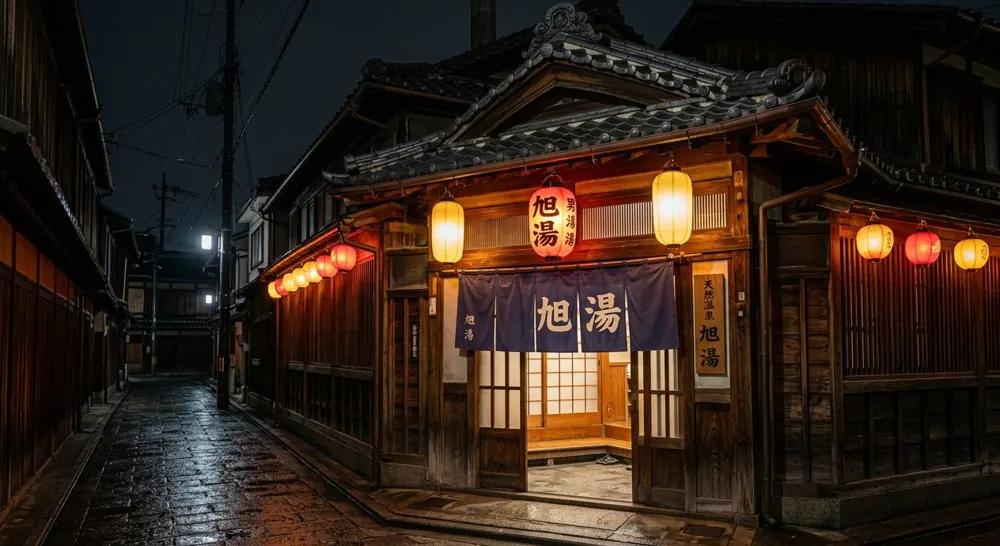
Tottori Onsen is a national rarity — a hot spring rising right in front of a prefectural-capital station — and this Shōwa-retro bathhouse at its heart is about five minutes' walk from JR Tottori Station. Old-style layout with a bandai counter and just one pool split into deep and shallow halves, but the 46°C-plus sodium-sulphate-chloride water is properly hot and leaves skin silky. Adults ¥550, children ¥200; open in two sessions, 06:00–10:00 and 14:00–24:00, closed the 2nd Monday and New Year's Day. No soap provided — bring or buy. Good after walking the Tottori sand dunes or castle ruins, or as a morning bath before an early train. Parking for 11 cars plus coin car parks nearby.
- Price (adult)
- ¥550
- Hours
- 06:00–10:00 & 14:00–24:00
- Closed
- 2nd Monday (next day if a holiday) & New Year's Day; open daily in Jan & Aug
- Access
- About 5 min on foot from the north exit of JR Tottori Station; about 15 min by car from Tottori IC
- Water type
- Sulfate spring
- Tattoos
- Ask ahead
- Admission
- Admission ¥550 (Tottori's uniform public-bath rate as of 2025; formerly ¥400–450), child rate available. Towel rental ¥30–50, soap and shampoo sold in sachets (bring your own), lockers, hair dryer charged. No rotenburo or sauna — a sento layout of indoor tubs (hot and mild) and wash stations only. Rest space is just a lobby bench. Cash. 'Morning bath' from 6 a.m.
- Baths
- The representative communal bath of Tottori Onsen, a nationally rare 'station-front spa' where several natural-hot-spring sento lie within a 5–10 minute walk of JR Tottori Station in the downtown of the prefectural capital. A Showa-retro bathhouse building, an everyday bath for locals. Handy for travellers as a 'morning or night bath' before or after the Tottori Sand Dunes (20 min by bus), the castle ruins and Karo port, or around overnight trains and buses. Four onsen sento within walking distance of the station, including Motoyu Onsen
- Spring water
- Tottori Onsen, a sodium-sulphate and chloride spring (weakly acidic to neutral, 46.6°C and pH 6.6 at source), recirculated and chlorinated with a faint chlorine smell. Pale-green-tinged clear water, slick with a slight tingle on entry, hot at 43–44°C to local taste. Indicated for neuralgia, muscle pain, poor circulation, cuts, skin conditions and fatigue. Tottori Onsen was discovered in 1904 while digging a well in the city
- Access & parking
- 5–10 min on foot from the north exit of JR Tottori Station (toward Suehiro-onsen-cho from the station avenue) — the nearest onsen sento to the station. 2 h 30 min from Osaka by Super Hakuto limited express; from Tokyo 1 h 15 min by air plus 20 min airport bus. By car 10 min from Tottori IC; few dedicated spaces (use coin parking). Sand Dunes 20 min by bus; castle ruins and Jinpukaku 20 min on foot
- Phone
- 0857-22-2648
- Open in Google Maps
- Google Maps ↗
Essentials
Find a stay on Trip.com
Search and book accommodation across Japan on Trip.com. Day-use bathing needs no booking.
Opens partner booking site (affiliate)
Why go
- 5 min from Tottori Station, spring by the tracks
- Shōwa-retro bandai bathhouse, hot water
- Open from 6 am; ¥550
A Showa-retro onsen sento in front of a prefectural capital's station — ¥550 from 6 a.m.
Hinomaru Onsen is an onsen sento in the heart of downtown Tottori, a 5–10 minute walk from JR Tottori Station. A natural hot spring rising right in front of a prefectural capital's main station is itself a national rarity; since Tottori Onsen was discovered in 1904 while digging a well in town, several onsen sento have grown up around the station to form a 'station-front spa', and Hinomaru is the closest to the station with the longest hours. The building is a Showa bathhouse unchanged, with no rotenburo or sauna — just indoor tubs and wash stations — but the pale-green-tinged sodium-sulphate and chloride water fills them at a hot 43–44°C, and it is cherished by onsen fans and backpackers as 'the easiest real onsen to slip into on a journey'. Admission is Tottori's uniform public-bath rate of ¥550, and with hours from 6 to 10 a.m. and 2 p.m. to midnight it fits any itinerary: a morning bath after an overnight bus, an evening soak after the dunes, a night bath before a late train. Closed only on the second Monday and New Year's Day (open daily in January and August), with towels for rent for a few dozen yen. Combine it with the Tottori Sand Dunes (20 minutes by bus), the castle ruins or crab dishes at Karo port, or make it your 'locals' bath' experience when staying in Tottori as a base for the San'in region.
A hot green spring taken with sento manners
Walk north along the station avenue and into the lanes of Suehiro-onsen-cho until you see the Showa signboard and chimney. Put your shoes in the entrance lockers, pay ¥550 at the bandai counter and you are in; rent a towel for a few dozen yen if needed and buy a sachet of soap and shampoo or bring your own. The changing room is a nostalgic space of wooden lockers, a scale and an electric fan; the bathroom a classic sento of tiled floor, two tubs — hot and milder — and wash stations along the wall. The water is clear with a pale green tint, slick when stirred, and the slight tingle on entry is characteristic of a sulphate-chloride spring; at 43–44°C it is hot to local taste, so do not plunge to the shoulders but go in from the feet, taking several short dips of a minute or two. Even the milder tub is 41–42°C. It is recirculated with a faint chlorine smell, yet the mineral content is unmistakable and you stay warm long after. Keep the iron rules of the sento — wash before entering, no towels in the water, do not splash your neighbour, dry off before the changing room — and you will blend in naturally with the local elders. Mornings 6–8 bring the pre-work regulars and evenings 6–9 the after-work crowd; after 10 p.m. and 2–5 p.m. are quiet. Afterwards a bottle of milk or coffee milk on the lobby bench is the sento ritual, and the many 'beef-bone ramen' shops and izakaya nearby — a Tottori speciality — make a fine night-bath-and-a-drink course. No photography; tattoos are tolerated relatively leniently as at most sento, but follow the posted notice.
Practical details and a Tottori station-front bath crawl
Hours are 6:00–10:00 and 14:00–24:00 (some sources 6–9 and 15–24; the on-site notice prevails); closed the second Monday of each month (next day if a holiday) and New Year's Day, open daily in January and August; ¥550 (child rate available), towel rental a few dozen yen, cash only, use coin parking. Access is 5–10 minutes on foot from the north exit of Tottori Station, 2 h 30 min from Osaka by limited express. Suggested routes: (1) a Tottori day — arrive by overnight bus, morning bath at Hinomaru, breakfast at a station cafe, bus to the Sand Dunes and the Sand Museum (sand sculptures), crab and seafood lunch at 'Karoichi' in Karo port, the castle ruins and Jinpukaku (a Meiji Western mansion), evening bath at Hinomaru, beef-bone ramen, then a hotel or the night bus; (2) a station-front sento crawl — Hinomaru (closest, from 6 a.m.), Motoyu Onsen (with a milder tub) and the other walkable onsen sento, two or three in a day (all a uniform ¥550); (3) across San'in — Tottori (Hinomaru), Hawai and Misasa Onsen (radium springs, 30 min by train), on to Matsue and Tamatsukuri; (4) winter — a night bath after a crab dinner at Karo port in the matsuba-gani season (November–March). Notes: no rotenburo, sauna or lounge (it is a sento); the water is hot, so take care with heart conditions and children; bring soap; carry coins for lockers and dryers; weekend evenings are crowded. It offers no luxury, but the rarity of 'a real onsen for ¥550 in front of a prefectural capital's station' is among the finest in Japan, and worth a stop for anyone passing through Tottori.
Before you go
- No official tattoo policy is published — ask at reception.
- As a communal bath there is no soap or shampoo — bring your own or buy at the shop.
- Payment is usually by ticket machine in cash — bring coins.
- Last entry is 30–60 minutes before closing.
Features
Baths
Mood & scenery
Convenience
Price
Who with
Amenities
✔ Verified operating: 2026-09 Operating status and rates cross-checked against the official site and onsen guides (full source notes in Japanese on the JA page)
Prices and hours change. Check official sources before visiting.
More in this area

Kabu-yu, Misasa
The original bath of Misasa, one of the world's most radon-rich springs. Locals take short dips in the hot water. Free foot bath and drinking fountain next door; the free riverside mixed bath is nearby.

Kaike Onsen O-yu Land
A hotel-attached day bath at the entrance to Kaike Onsen on the Sea of Japan coast in Yonago. While ryokan in Kaike charge around ¥1,500 for day use, here ¥450 covers the indoor bath, rotating specialty bath, rotenburo and jacuzzi (¥580 with sauna). Open straight through 10:00–23:00 daily. Close to the beach, so busy with swimmers in summer. 20 minutes by bus from Yonago Station.

Iwai Yukamuri Onsen Public Bath
Twenty minutes by car from the Tottori Sand Dunes, the communal bath of Iwai Onsen, one of San'in's oldest springs at 1,300 years. It preserves 'yukamuri', a quirky custom of singing while ladling water over a towel on your head. The 47.6°C source in a corner of the car park flows in 100% untreated. ¥380, open 6:00–22:00. A humble soak to pair with the Uradome coast or the dunes.