Kumamoto · Yamaga & Hirayama Onsen
Yamaga Onsen Sakura-yu
山鹿温泉 さくら湯
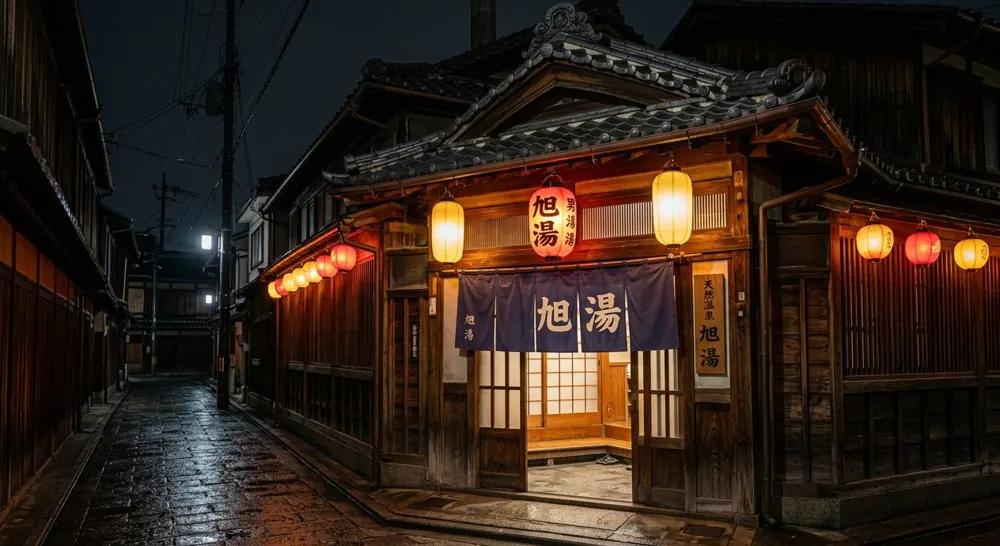
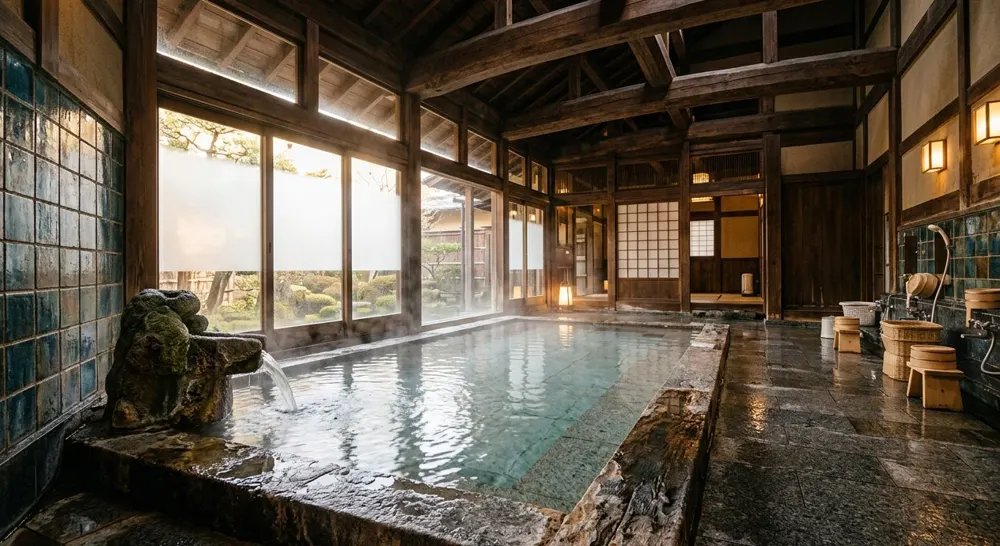
One of Kyūshū's largest wooden bathhouses, in the centre of the old castle town of Yamaga in northern Kumamoto. Built in the Edo period as a rest house for the Hosokawa lords, its Meiji-era rebuild is attributed to Sakamoto Matahachirō, the master carpenter of Dōgo Onsen Honkan. Faithfully reconstructed in 2012, the curved-gable entrance, dragon transoms and high-ceilinged bath hall feel far grander than the ¥350 admission. The water is a clear, silky alkaline simple spring, with a drinking fountain. Open long hours, 6:00–24:00 (last entry 23:30), closed the 3rd Wednesday. Soap and towels from the vending machine. Combine with the Yachiyoza theatre (Important Cultural Property), the Buzen Kaidō streetscape and the August lantern festival.
- Price (adult)
- ¥350
- Hours
- 06:00–24:00 (last entry 23:30)
- Closed
- 3rd Wednesday (next weekday if a holiday)
- Access
- About 80 min by Kyūshū Sankō bus from JR Kumamoto Station to Yamaga Onsen Plaza; or about 35 min by bus from JR Tamana Station; 15 min by car from Kikusui IC
- Water type
- Alkaline simple
- Tattoos
- Ask ahead
- Admission
- Adults (junior high and up) ¥350, children (3 to elementary) ¥150, ¥50 off for JAF members. Shampoo, conditioner and body soap sold at ¥100 each (none provided), towels ¥100, lockers ¥10, dryers free. Partner car park 2 hours free. A free 2nd-floor museum shows pre-rebuild photographs and the restored heritage 'Dragon Bath'. No family bath. Open 6 a.m. to midnight almost every day of the year
- Baths
- 'Yamaga Onsen Motoyu Sakurayu' stands at the heart of the old Buzen-kaido post town of Yamaga, Kumamoto. Opened in 1640 as a tea pavilion for Hosokawa Tadatoshi, lord of Higo, it flourished as the townspeople's great public bath in the Meiji era, was demolished in 1973, and in 2012 the Meiji wooden bathhouse with its karahafu gabled roof was rebuilt using traditional methods. One of Kyushu's largest wooden bathhouses, with a high-ceilinged hall of free-flowing alkaline simple water and a museum upstairs. Four minutes' walk from Yachiyoza, a Meiji-era kabuki theatre (Important Cultural Property), in the town of the August Yamaga Lantern Festival
- Spring water
- Yamaga Onsen, an alkaline simple spring of around pH 9 and 40–45°C at source, fully free-flowing with no dilution or heating. Colourless and odourless, famous as a silky-smooth 'beauty bath', mild enough for long soaks. Indicated for neuralgia, muscle pain, poor circulation, fatigue and skin care. Yamaga's abundant flow feeds many communal baths in town, and with nearby Hirayama Onsen it forms the twin peaks of 'Yamaga's beauty waters'
- Access & parking
- About 1 h 15 min from Kumamoto Station by Sanko bus to Yamaga Bus Centre (1 h from the Kumamoto bus terminal), then 5 min on foot. 40 min by car from JR Tamana Station or Kumamoto Airport. By car 15 min from Kikusui IC or 20 min from Ueki IC on the Kyushu Expressway. Partner city car park in front 2 hours free. Yachiyoza 4 min, Yamaga Lantern Folk Art Museum 3 min on foot
- Phone
- 0968-43-3326
- Official site
- yamaga-tanbou.jp ↗
- Open in Google Maps
- Google Maps ↗
Essentials
Find a stay on Trip.com
Search and book accommodation across Japan on Trip.com. Day-use bathing needs no booking.
Opens partner booking site (affiliate)
Why go
- Kyūshū's grandest wooden bathhouse, rebuilt 2012
- ¥350, open 6:00–24:00
- With Yachiyoza and the old high street
From a lord's tea pavilion to the people's bath: a rebuilt Meiji wooden onsen for ¥350
Yamaga Onsen Sakurayu is a great wooden bathhouse in the very centre of Yamaga, Kumamoto, a town that prospered as a post station on the Edo-period Buzen-kaido. Its history began in 1640 as a tea pavilion where Hosokawa Tadatoshi, lord of Higo, rested on his journeys of alternate attendance; in the Meiji era it was opened to the townspeople and flourished as a large wooden public bath with a karahafu gabled roof; demolished in redevelopment in 1973, it was rebuilt in 2012 at the citizens' wish, by traditional methods and true to its Meiji form. One of Kyushu's largest wooden bathhouses, its broad stone-floored hall beneath a high coffered ceiling receives Yamaga's alkaline simple water untouched — no dilution, no heating — a silky 'beauty bath' for a mere ¥350. Open from 6 a.m. to midnight, it allows a morning dip after an early stroll or a late soak after a show at Yachiyoza; in neighbourhood-bath style no shampoo is provided, so buy some for ¥100 or bring your own. The free museum upstairs displays photographs from before demolition and the restored old 'Dragon Bath', a designated cultural property, making the building a museum in itself. Four minutes' walk away is Yachiyoza, a Meiji kabuki theatre and Important Cultural Property, and in August the town holds the Yamaga Lantern Festival, where women dance with gold-paper lanterns on their heads. Just over an hour by bus from Kumamoto city, it makes an ideal half-day on a Kumamoto trip.
The great hall beneath a coffered ceiling, and silk-smooth free-flowing water
Enter through the karahafu-roofed main entrance, pay ¥350 at reception (buying shampoo or a towel for ¥100 each if needed) and follow the corridor to the gender-separated changing rooms, old public-bath style with wooden baskets and ¥10 lockers. Open the bathroom door and a vast space appears — a coffered ceiling nearly ten metres high, thick pillars, a stone floor — and though rebuilt it stirs the feeling of stepping back into Meiji. The big central pool is divided into a milder and a slightly hotter side, both free-flowing, and the near-pH 9 alkaline water slides under your palm as if soaped, proving 'Yamaga's beauty bath' no exaggeration. At a gentle 40–42°C it suits an unhurried half hour; there are plenty of wash stations but no soap, so come prepared. With no sauna or outdoor bath, it is a space purely for 'enjoying the water'. Around 6 a.m. it is a daily gathering place where local elders exchange greetings, midday brings tourists, and after 10 p.m. it is quiet. Afterwards visit the free museum upstairs — photographs of the old Sakurayu, the restored and stately 'Dragon Bath', records from its tea-pavilion days — and rest in the ground-floor lounge with Yamaga's famous yokan or a Sakurayu cider. The square in front is lit at dusk, showing the gabled roof at its best, and Yachiyoza, the Lantern Folk Art Museum and the retro shops of the Buzen-kaido are all within five minutes' walk.
Practical details and a Yamaga / north Kumamoto route
Hours are 6:00–24:00 (last entry 23:30), closed the third Wednesday of each month (next weekday if a holiday); adults ¥350, children ¥150, shampoo and towels ¥100 each, partner car park 2 hours free. Access is 1 h to 1 h 15 min by Sanko bus from Kumamoto Station or the bus terminal to 'Yamaga Bus Centre' then 5 min on foot, 15 min by car from Kikusui IC on the Kyushu Expressway, or 1.5 h by car from Fukuoka — a day drive from Fukuoka is feasible too. Suggested routes: (1) a day from Kumamoto — arrive in Yamaga in the morning, tour Yachiyoza (interior open on non-performance days, revolving stage and box seats), the Lantern Folk Art Museum, lunch among the sake breweries and old townscape of the Buzen-kaido (Yamaga's Takeshima somen, horse meat), a bath at Sakurayu, then back to Kumamoto or a night at Hirayama Onsen; (2) a bath-hop — Sakurayu (beauty bath), 15 minutes by car to Hirayama Onsen Motoyu (¥400, equally silky), then Kikuchi Gorge (summer cool, autumn colour); (3) festivals — the Yamaga Lantern Festival on 15–16 August (the thousand-lantern dance; book lodgings months ahead) and the February Yamaga Lantern Roman 'Hyakka Hyakusai' night walk. Sakurayu is a locals' everyday bath, so bring soap and shampoo, keep voices down and observe communal-bath manners; check the tattoo policy on the notice board. Forty minutes by car from Kumamoto Airport, it is handy as a first stop after landing or a last bath before departure.
Before you go
- No official tattoo policy is published — ask at reception.
- As a communal bath there is no soap or shampoo — bring your own or buy at the shop.
- Payment is usually by ticket machine in cash — bring coins.
- Last entry is 30–60 minutes before closing.
Features
Mood & scenery
Price
Convenience
Amenities
✔ Verified operating: 2026-09 Operating status and rates cross-checked against the official site and onsen guides (full source notes in Japanese on the JA page)
Prices and hours change. Check official sources before visiting.
More in this area

Kurokawa Onsen Nyuto Tegata (bath-hopping pass)
One cedar 'nyuto tegata' pass (¥1,500) admits you to any three of the rotenburo at Kurokawa's 26-odd ryokan. Valid for six months, and one of the three stickers can be spent on food or souvenirs instead. Most inns accept bathers roughly 8:30–21:00, but hours vary and some close for cleaning or when full. Buy the pass at any ryokan or the association office 'Kaze no Ya'.

Ana-yu communal bath
A tiny bath hut on the Tanohara River, rebuilt by donations in 2022 after the 2020 floods (now separate men's and women's rooms). Slide the shutters open and it becomes almost open-air. ¥200 in the box.

Jizō-yu (Kurokawa communal bath)
The oldest communal bath in town, next to the Jizō hall that gives Kurokawa its identity. Not covered by the bath-hopping pass, but only ¥200. No soap; the water runs hot.