Kumamoto · Yamaga & Hirayama Onsen
Hirayama Onsen Motoyu
平山温泉 元湯
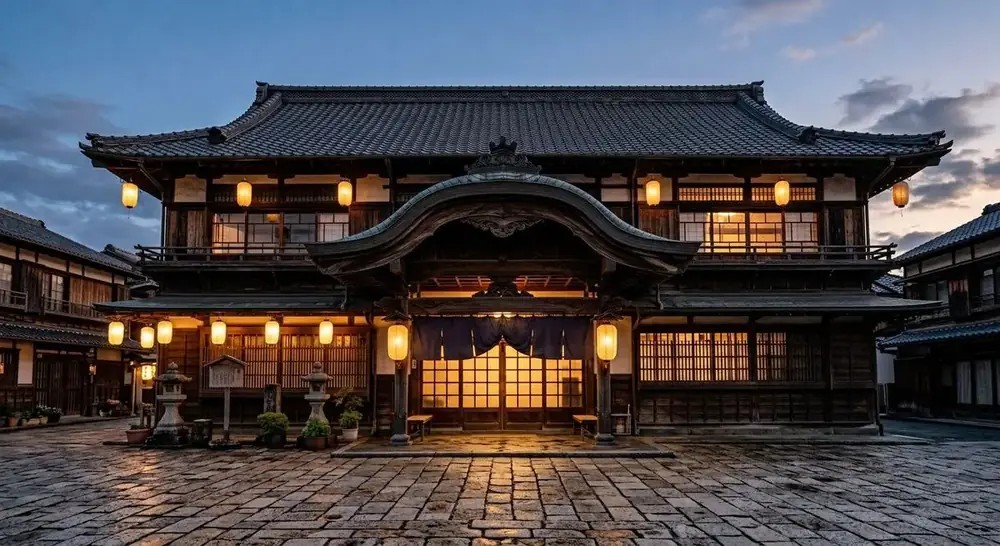
The communal bath at the centre of Hirayama Onsen, a scatter of quiet inns in the hills ten minutes by car from Yamaga. The 1961 Hirayama Onsen Center was rebuilt in 2016 with an open-air bath added to the indoor one. The water is Hirayama's signature slippery alkaline sulphur spring — called one of Kyūshū's finest skin-beautifying baths — used 100% free-flowing. You can drink it or take some home, and the lobby sells local vegetables and eggs. ¥400; open 6:00–21:30, every day. About 11 minutes by bus from Yamaga bus centre to Hirayama-Onsen-mae, then a minute on foot. Combine with Sakura-yu for a Yamaga bath-hop.
- Price (adult)
- ¥400
- Hours
- 06:00–21:30 (last entry 21:00)
- Closed
- Open daily (some sources: irregular closures)
- Access
- About 11 min by Kyūshū Sankō bus (for Nankan-Kamimachi) from Yamaga bus centre to Hirayama-Onsen-mae, then 1 min on foot; 20 min by car from Nankan IC or 18 min from Kikusui IC
- Water type
- Sulfur spring
- Tattoos
- Ask ahead
- Admission
- Adults (junior high and up) ¥400, children (3 to elementary) ¥200 (older sources say ¥300). No shampoo or soap provided (small portions sold at reception), towels sold, dryers free, Wi‑Fi. Gender-separated indoor hall (one large tub) and a small outdoor bath; private family baths charged separately (timed, confirm on site). Free parking for 30. A simple rest room
- Baths
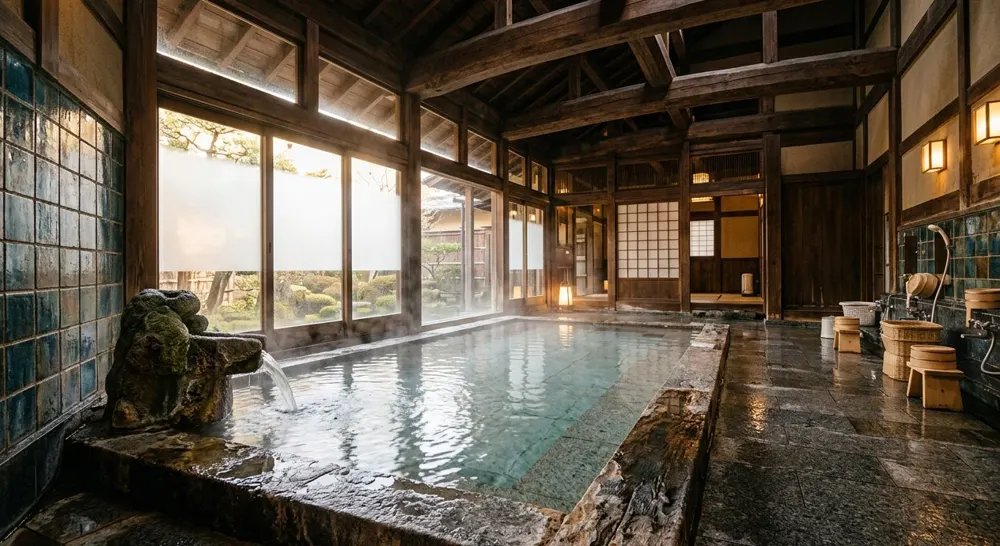
- Fifteen minutes by car from Yamaga town, amid rice fields and hills, 'Motoyu' is the birthplace and symbol of Hirayama Onsen. Its recorded history spans 1,300 years, known since the Kamakura period as a cure for skin ailments. The strongly alkaline sulphur spring of around pH 9.7 is lotion-slick — one of Kyushu's foremost 'beauty' and 'skin' baths. A modern building with a large indoor hall and a small outdoor tub, gathering locals and bath-hoppers from 6 a.m. More than ten private-family-bath specialists cluster nearby, making it famous as the 'village of family baths'
- Spring water
- Hirayama Onsen, an alkaline simple sulphur spring of around pH 9.7 (among Japan's most alkaline), about 44°C at source, fully free-flowing with no dilution, heating or chlorination. Colourless with a faint sulphur scent, it makes the skin feel slick as if coated in lotion, dissolving dead skin so the smoothness lasts long after. Indicated for skin conditions, atopic dermatitis, neuralgia, rheumatism, cuts and poor circulation. Mild in temperature — long soaks are the rule
- Access & parking
- 30–40 min by car from JR Shin-Omuta or Tamana stations, 50 min from Kumamoto Station, 1.5 h from Fukuoka. Sanko bus from Yamaga Bus Centre toward Hirayama Onsen about 20 min (only a few a day) to 'Hirayama Onsen' then 3 min on foot. By car 15 min from Nankan IC or 20 min from Kikusui IC on the Kyushu Expressway. Free parking for 30. Yamaga Sakurayu 15 min by car
- Phone
- 0968-43-2041
- Official site
- hirayama-onsen.jp ↗
- Open in Google Maps
- Google Maps ↗
Essentials
Find a stay on Trip.com
Search and book accommodation across Japan on Trip.com. Day-use bathing needs no booking.
Opens partner booking site (affiliate)
Why go
- Slippery 'finest skin bath in Kyūshū'
- 100% free-flowing, ¥400
- From 6:00, open every day
pH 9.7 and lotion-slick: one of Kyushu's great beauty baths for ¥400
Hirayama Onsen Motoyu is the communal bath that is both birthplace and symbol of the quiet spa village of Hirayama, set among rice fields and low hills in the north of Yamaga, Kumamoto. Its history is said to span 1,300 years, known since the Kamakura period as a cure for skin ailments, and the sole reason onsen lovers still drive here from Yamaga, Tamana, Omuta and even Fukuoka is the quality of the water. A strongly alkaline simple sulphur spring of around pH 9.7 flows in untouched — no dilution, heating or chlorine — and the moment you sink in your skin turns slick as if coated in lotion; by the time you climb out the dead skin has dissolved and the back of your hand is noticeably smooth, earning it the accolade 'Kyushu's finest beauty bath'. The building is modern and plain, with one big indoor pool, a small outdoor tub and a simple rest room, but for ¥400 it is open from 6 a.m. to 9:30 p.m. nearly every day of the year, and pairing it with Yamaga Sakurayu (15 minutes by car) as a 'two beauty baths of Yamaga' circuit is the classic onsen-fan itinerary. More than ten private family-bath specialists cluster around Hirayama, so families and couples can choose privacy while purists choose Motoyu's great tub.
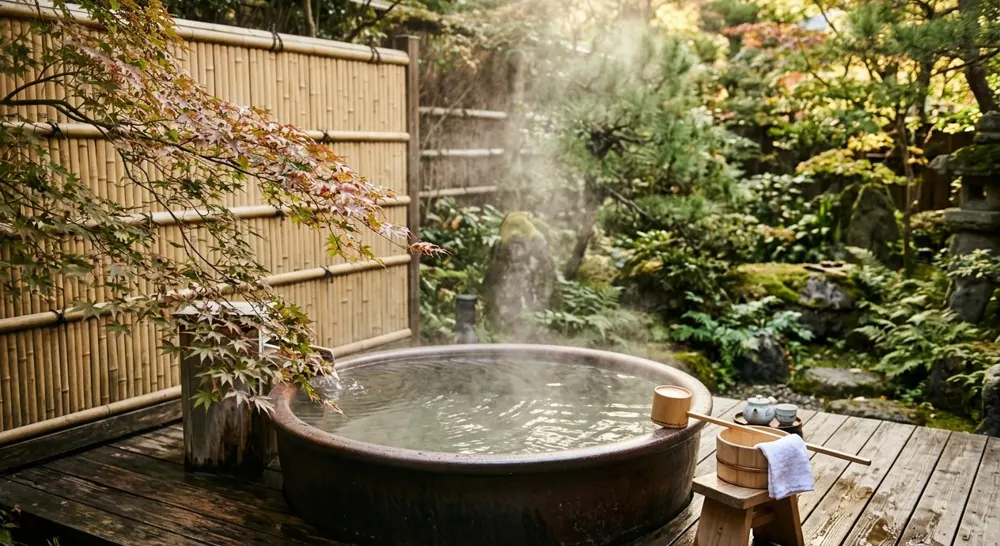
A great indoor pool that smooths the back of your hand, and a small rotenburo
From the car park enter the modern single-storey building, pay ¥400 at reception (no soap or shampoo provided — bring your own or buy small portions) and head to the gender-separated changing rooms. The bathroom is a bright tiled space centred on one large pool; water of about 44°C at source flows in unheated, settling at 41–42°C in the tub and overflowing all day. The slipperiness you feel on entering is in a different league from other alkaline springs — at first you wonder whether something has been added — and a faint sulphur scent lingers at the nose. Being mild, it rewards a leisurely 20–30 minutes, after which your skin feels as if a layer has been shed, a sensation that lasts into the next day. A door at the back leads to a small outdoor bath for a breath of fresh air, though the view is modest. There is no sauna or jets, and as an everyday bath full of local elders, communal manners matter: wash before entering and keep towels out of the water. It is busy with residents from 6 to 8 morning and evening, quiet at midday. Afterwards browse the spring-water lotion and soap sold beside reception, and eat at one of the village's family-bath restaurants (Yamaga horse meat, local vegetables) or on Tamana ramen in Tamana. Those with sensitive skin may find the strong alkali drying, so moisturise after bathing, and watch children on the slippery floor.
Practical details and a Yamaga–Tamana beauty-bath route
Hours are 6:00–21:30 (last entry 21:00), open all year (some sources say irregular; closed for equipment checks); adults ¥400, children ¥200 (older sources say ¥300); no shampoo; free parking for 30. Public transport is poor (a few buses a day from Yamaga Bus Centre), so a rental car is the realistic choice — 15 minutes from Nankan IC on the Kyushu Expressway, 50 from Kumamoto Station, 1.5 hours from central Fukuoka. Suggested routes: (1) a Yamaga beauty-bath circuit — Sakurayu (¥350, Meiji wooden building), Yachiyoza, Hirayama Motoyu (¥400), one more family bath (50–60 min for ¥1,500–2,500, for couples and families), a night at a Hirayama inn (many quiet toji lodgings); (2) an overnight in north Kumamoto — Kumamoto Castle, Yamaga, a night in Hirayama, then Kikuchi Gorge or a drive across the Tamana plain with Tamana ramen, and the Ariake coast (Miike coal-mine heritage); (3) a day from Fukuoka — 1.5 hours on the expressway, a bath at Motoyu plus a stroll in Yamaga, then home. All of Yamaga is crowded for the Lantern Roman in February and the Lantern Festival on 15–16 August. Motoyu is a plain bath that 'stakes everything on the water', so if you want comfort the nearby family-bath facilities or inn day-bathing (about ¥1,000) are alternatives; onsen devotees should aim for the freshest water right after the 6 a.m. opening.
Before you go
- No official tattoo policy is published — ask at reception.
- As a communal bath there is no soap or shampoo — bring your own or buy at the shop.
- The water runs hot (43–45°C). Don't add cold water; take short repeated dips instead.
- Payment is usually by ticket machine in cash — bring coins.
- Last entry is 30–60 minutes before closing.
Features
Price
Convenience
Amenities
✔ Verified operating: 2026-09 Operating status and rates cross-checked against the official site and onsen guides (full source notes in Japanese on the JA page)
Prices and hours change. Check official sources before visiting.
More in this area

Kurokawa Onsen Nyuto Tegata (bath-hopping pass)
One cedar 'nyuto tegata' pass (¥1,500) admits you to any three of the rotenburo at Kurokawa's 26-odd ryokan. Valid for six months, and one of the three stickers can be spent on food or souvenirs instead. Most inns accept bathers roughly 8:30–21:00, but hours vary and some close for cleaning or when full. Buy the pass at any ryokan or the association office 'Kaze no Ya'.

Ana-yu communal bath
A tiny bath hut on the Tanohara River, rebuilt by donations in 2022 after the 2020 floods (now separate men's and women's rooms). Slide the shutters open and it becomes almost open-air. ¥200 in the box.

Jizō-yu (Kurokawa communal bath)
The oldest communal bath in town, next to the Jizō hall that gives Kurokawa its identity. Not covered by the bath-hopping pass, but only ¥200. No soap; the water runs hot.