Kumamoto · Tsuetate Onsen
Tsuetate Onsen Moto-yu communal bath
杖立温泉 共同湯 元湯
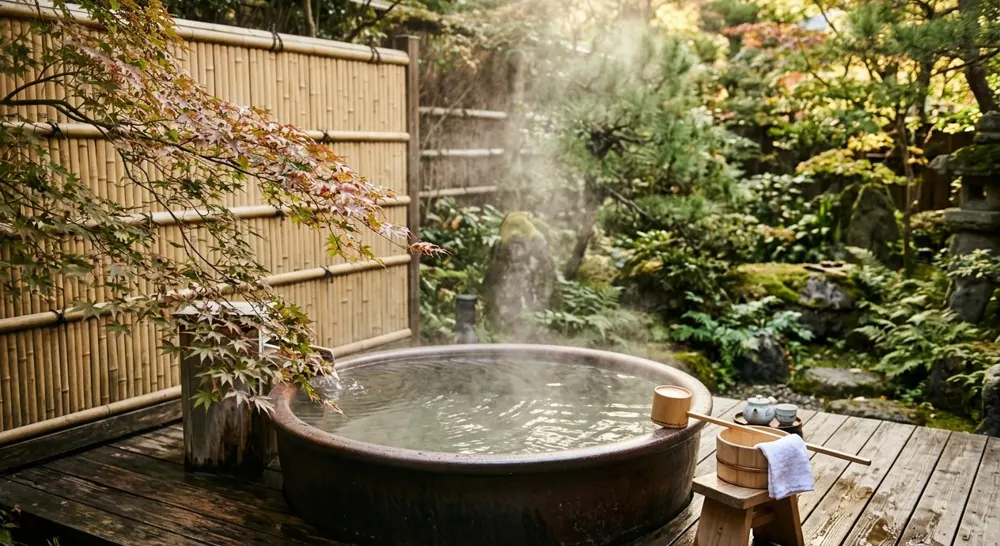
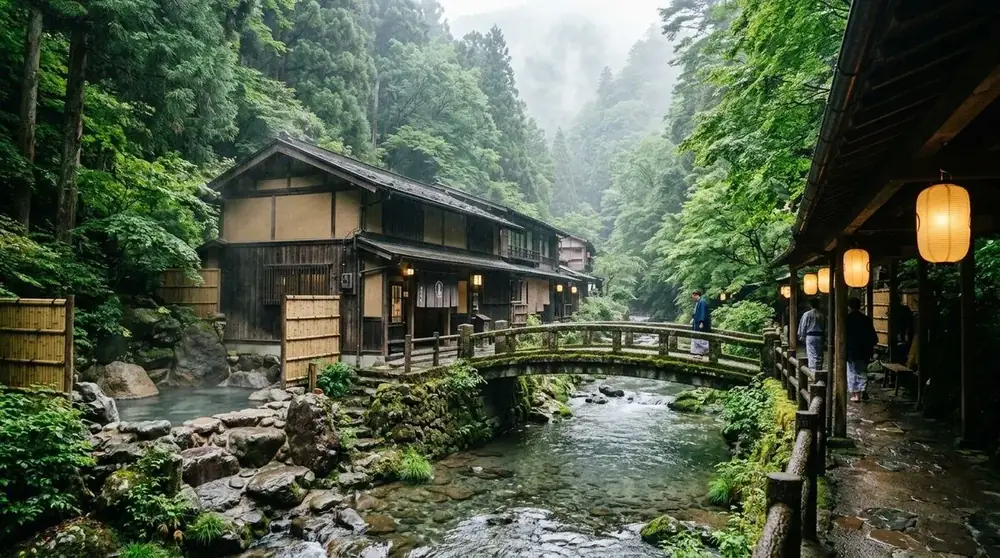
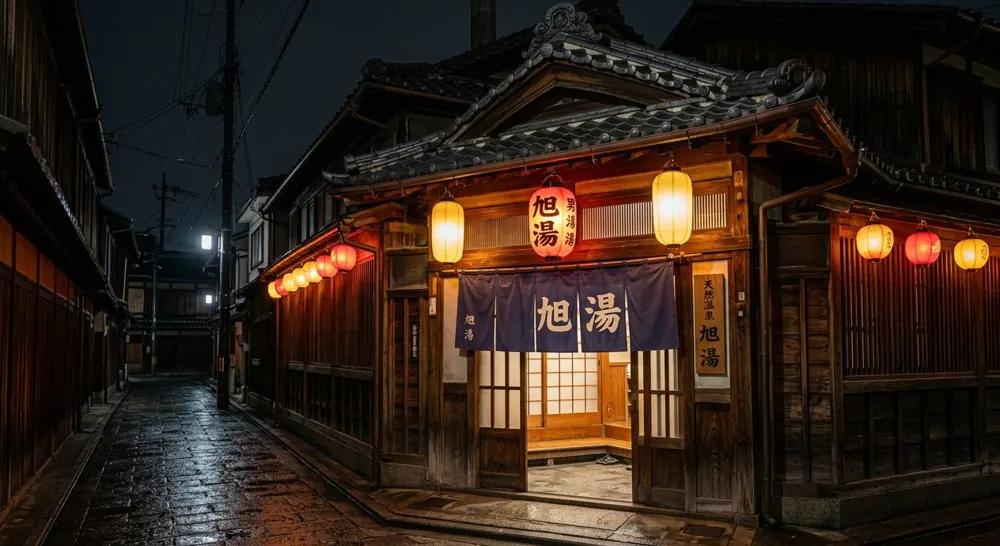
Tsuetate Onsen, where inns line both banks of the Tsuetate River on the Kumamoto–Ōita border, claims 1,800 years of history as the bath water of the infant Emperor Ōjin. Moto-yu is the communal bath said to be its origin: a single half-open tub carved into the rock face beside the riverside promenade — mixed, free and open 24 hours, nothing more. The sodium-chloride water, cooled from a 98°C source, leaves the skin soft. Changing space is basic and screening minimal, so many people wear bathing garments or a wrapped towel; early morning or night is the best time. Combine it with a wander through the 'sedoya' back alleys and, in May–June, the 3,500 carp streamers strung across the river. About 50 minutes by bus from Hita Station.
- Price (adult)
- Donation / free
- Hours
- 24 hours (closed during cleaning or when water temperature is unsuitable)
- Closed
- Open daily (occasionally closed for maintenance)
- Access
- About 50 min by Hita bus from JR Hita Station to 'Tsuetate', then 3 min on foot; about 40 min by car from Hita IC
- Water type
- Simple spring
- Tattoos
- Ask ahead
- Admission
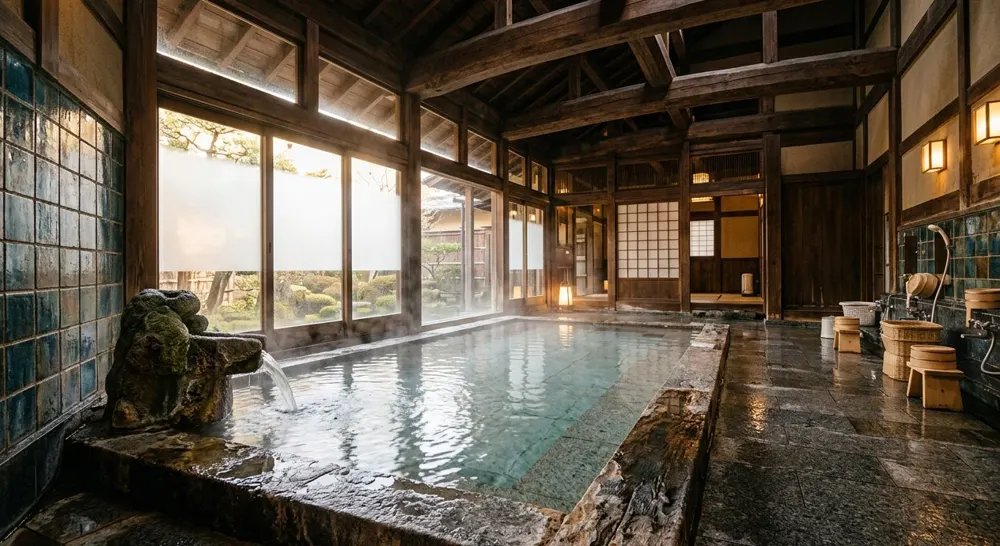
- Free to bathe (donation box; ¥100–200 suggested). Open 24 hours, but closed when local volunteers clean it or when the water is too hot or too cool (sign at the entrance). One mixed cave-like semi-open pool on the riverbed. No wash area, soap or shower; bring a towel and bathing wrap; a tap lets you cool the water (remember to turn it off). Rudimentary changing space. No photography. Park in the spa town's public car parks (paid, some free). Other communal baths: Gozen-yu (paid, separate) and Yakushi-yu
- Baths
- The founding source of Tsuetate Onsen, a Showa-retro spa town strung along the Tsuetate River gorge in Oguni, Kumamoto, on the Oita border (legend says it was Emperor Ojin's first bath about 1,800 years ago). A cave-like semi-open mixed pool among the rocks of the riverbed, a free communal bath maintained by goodwill of residents. The town is famed for its koinobori festival (3,500 carp streamers in April–May), the 'Sedoya' back-alley walk, steam baths and dishes steamed by hot-spring vapour. Kurokawa Onsen 20 min by car, Yufuin 1 h, Hita 40 min
- Spring water
- Tsuetate Onsen, a sodium-chloride spring (about 98°C at source, weakly alkaline). Colourless with a slight salty taste and strong heat retention — a 'heat bath'. Motoyu runs source water straight in, so it is often hot and you cool it with the tap; at times it turns tepid, so hitting the 'right temperature' is partly luck. Indicated for neuralgia, rheumatism, poor circulation, cuts and skin conditions. The town's 98°C steam baths and steam-kettle cooking are specialities
- Access & parking
- From JR Hita Station, Hita bus bound for Tsuetate Onsen about 50 min to the terminus, then 5 min on foot. 1 h 10 min by car from Kumamoto Airport, 2 h from Fukuoka city, 20 min from Kurokawa Onsen, 1 h from Yufuin. The spa town is a maze of narrow lanes, so leave the car at the public car park at the entrance and walk. Motoyu is down the steps to the riverbed near Momiji Bridge (ask at the tourist office)
- Phone
- 0967-48-0206
- Official site
- tsuetate-onsen.com ↗
- Open in Google Maps
- Google Maps ↗
Essentials
Find a stay on Trip.com
Search and book accommodation across Japan on Trip.com. Day-use bathing needs no booking.
Opens partner booking site (affiliate)
Why go
- Origin bath with 1,800-year legend, free 24 h
- Half-open rock tub on the river promenade
- Sedoya alleys; carp streamers May–Jun
The founding spring of an 1,800-year legend: a free mixed cave bath on the riverbed
Tsuetate Onsen Motoyu is the founding source of Tsuetate Onsen, a spa town of Showa-era inns and lanes packed into a deep gorge in Oguni, Kumamoto, on the Oita border. Legend holds that Emperor Ojin was given his first bath in this water some 1,800 years ago, and the place name — 'cane left standing' — comes from invalids who arrived on canes and walked away without them after bathing here. The whole facility is a single mixed semi-open pool sunk like a cave among the rocks of the riverbed, a free communal bath cleaned and cared for by local goodwill, with no luxuries whatsoever — yet to onsen devotees it is known as one of 'the wildest communal baths in Kyushu'. The 98°C chloride source flows straight in, so the water is often too hot and you cool it with the tap; at other times it turns tepid, and 'getting lucky with the right temperature' is part of the fun. It is open around the clock, but a 'no bathing' sign may appear during cleaning or when the water is unsuitable; the changing space is so basic it is visible from outside, so bring a bathing wrap or towel and never take photographs. The town also offers the paid communal baths Gozen-yu (separate) and Yakushi-yu, steam baths and dishes cooked in 98°C vapour, the 'Sedoya' back-alley walk, and a festival of 3,500 carp streamers filling the gorge in April–May; combined with Kurokawa Onsen (20 minutes by car) it delivers Showa nostalgia and a hidden communal bath in one trip.
How to bathe in the cave pool: cooling, manners and the lucky right temperature
From the public car park at the town entrance or the bus terminus, walk along the Tsuetate River and look for the steps down to the riverbed near Momiji Bridge; beneath the rocks you will see a small roof and a 'Motoyu' sign. If the entrance shows 'cleaning' or 'too hot — no bathing', give up and go to Gozen-yu. The changing space is just a shelf and screen beside the rock and may be visible from the path, so women wear a bathing wrap and men too wrap a towel and slip in quickly; large bath towels in the water are forbidden. The pool holds two or three people and the rock ceiling is low, so stoop to enter; test the water with your hand and, if hot, open the tap on the wall to cool it (always turn it off when you leave — otherwise the next bather finds it tepid). The chloride water tastes salty and keeps you sweating long after; the cave is dim, the river glimpsed through gaps in the rock, and the sense of soaking in 'the water of the earth' is intense. Soap and shampoo are banned and there is no wash area, so wash at your inn or at Gozen-yu. Putting ¥100–200 in the donation box is good manners. If mixed bathing worries you, early morning (6–7) or inn dinner time (18–19) tends to be empty; night is not advised as lighting is dim and the riverbed steps slippery. Photography is strictly forbidden (a condition of the local caretakers), and keeping your voice down is the courtesy owed to the residents who keep this bath open for free.
Practical notes and a Tsuetate–Kurokawa route
Motoyu is free and open 24 hours, but there is no guarantee you can get in at any given moment. A 'no bathing' sign goes up during volunteers' cleaning (mostly mornings), when the source is too hot or too cool, or when the river rises; the Tsuetate Onsen tourist association (0967-48-0206) can confirm conditions. There are no facilities, so bring a towel, bathing wrap, change of clothes and a plastic bag, and shower at your inn or at the paid communal bath Gozen-yu (separate, a few hundred yen). Access is 50 minutes by bus from JR Hita Station to the terminus, or by car 1 h 10 min from Kumamoto Airport and 2 h from Fukuoka; the town's lanes are closed to cars, so park at the entrance. Suggested routes: (1) half a day in Tsuetate — the 'Sedoya' back alleys (Showa signage, narrow stairways), a steam-bath try and snacks of steamed eggs and vegetables, a bath at Motoyu or Gozen-yu, then a riverside footbath; (2) with Kurokawa — tour the rotenburo of Kurokawa Onsen on the 'nyuto tegata' pass (20 min by car), stay in a Showa-retro inn in Tsuetate, morning bath at Motoyu; (3) April–May koinobori — see 3,500 carp streamers spanning the gorge (early April to early May), then Motoyu; (4) around Oguni — Nabegataki Falls (walk behind the curtain), the Oguni cedars and the old streets of Mameda-machi in Hita (40 min by car). The gorge is cold in winter and roads may ice, yet that is also when the hot Motoyu feels best. Understand that Motoyu is not a 'facility' but a 'culture' sustained by local goodwill, and if you are unsure you can enjoy it without strain, choosing Gozen-yu instead is also the right call.
Before you go
- No official tattoo policy is published — ask at reception.
- As a communal bath there is no soap or shampoo — bring your own or buy at the shop.
- There is a mixed-gender area. Check the description for bathing garments and women-only hours.
- Last entry is 30–60 minutes before closing.
Features
Mood & scenery
Convenience
Price
Who with
Only here
✔ Verified operating: 2026-09 Operating status and rates cross-checked against the official site and onsen guides (full source notes in Japanese on the JA page)
Prices and hours change. Check official sources before visiting.
More in this area

Kurokawa Onsen Nyuto Tegata (bath-hopping pass)
One cedar 'nyuto tegata' pass (¥1,500) admits you to any three of the rotenburo at Kurokawa's 26-odd ryokan. Valid for six months, and one of the three stickers can be spent on food or souvenirs instead. Most inns accept bathers roughly 8:30–21:00, but hours vary and some close for cleaning or when full. Buy the pass at any ryokan or the association office 'Kaze no Ya'.

Ana-yu communal bath
A tiny bath hut on the Tanohara River, rebuilt by donations in 2022 after the 2020 floods (now separate men's and women's rooms). Slide the shutters open and it becomes almost open-air. ¥200 in the box.

Jizō-yu (Kurokawa communal bath)
The oldest communal bath in town, next to the Jizō hall that gives Kurokawa its identity. Not covered by the bath-hopping pass, but only ¥200. No soap; the water runs hot.