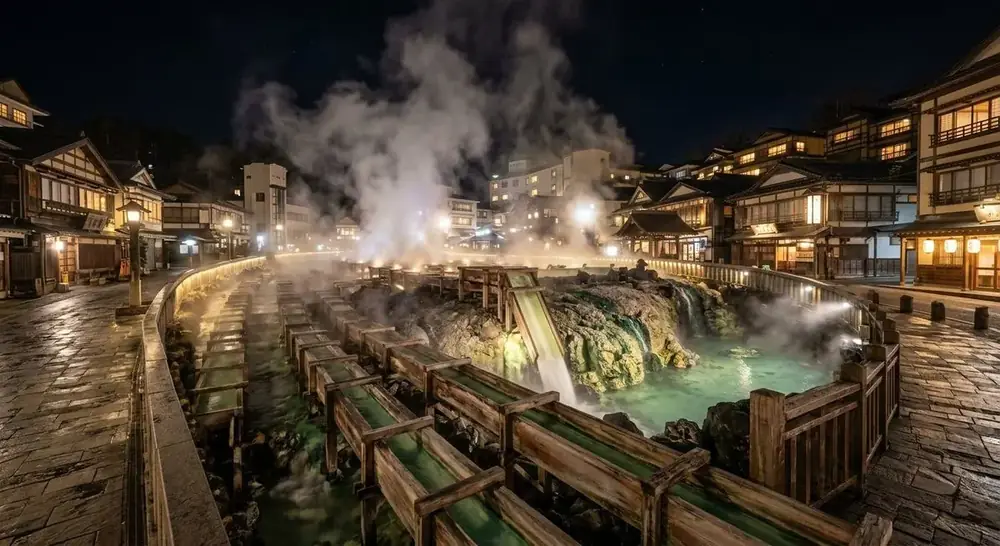
Gunma · Kusatsu Onsen
Sainokawara Open-Air Bath
西の河原露天風呂
A 10-minute walk west of Kusatsu's Yubatake, at the far end of Sainokawara Park, lies one of Japan's largest open-air baths. Around 500 m² of pool brims with strongly acidic water, open to the surrounding forest. Snow in winter, fresh green in summer, illuminations at night. There are no washing stations — this is purely for soaking.
- Price (adult)
- ¥800
- Hours
- Apr 1–Nov 30 07:00–20:00 / Dec 1–Mar 31 09:00–20:00 (last entry 19:30)
- Closed
- Open daily
- Access
- 15 min walk from Kusatsu Onsen Bus Terminal
- Water type
- Acidic spring
- Tattoos
- Not allowed
- Spring type
- Acidic sulphur-aluminium-sulphate-chloride spring (Bandaikō source). Source temperature about 94–96°C, pH about 1.7 — strongly acidic. Free-flowing, cooled with added water, no recirculation
- Baths
- Open-air baths only, separate for men and women (about 500 m² combined; no indoor bath or washing stations). Every Friday 17:30–20:00 the men's side becomes mixed bathing (bathing garments allowed)
- Combo ticket
- Three-bath pass ¥1,950 (Sainokawara, Ōtaki-no-yu and Gozanoyu, one entry each, no expiry)
- Phone
- 0279-88-6167
- Official site
- sainokawara.com ↗
- Open in Google Maps
- Google Maps ↗
Essentials
Stay in this onsen town
Compare and book stays in Kusatsu Onsen. Day bathing itself needs no booking.
Opens partner booking site (affiliate)
Why go
- One of Japan's largest open-air baths
- Strongly acidic Kusatsu water
- Snow views and night illumination
What it is like
About 10 minutes' walk west of the Yubatake, at the far end of Sainokawara Park where hot water bubbles out of the ground on all sides, this is the largest day-use open-air bath in Kusatsu. Opened by the town in 1987 and fully renovated in May 2015, its men's and women's pools total about 500 m² — each roughly the size of a 25 m swimming pool, ringed by forest and rocky slopes, an openness no ryokan bath in Kusatsu can match. The water comes from the Bandaikō source, Kusatsu's most abundant, and at around pH 1.7 it is among the most acidic in Japan. The pool is hot near the inlet and noticeably cooler along the far edge, so the local habit is to wander until you find your temperature. At about 1,250 m elevation it offers snow bathing in winter, autumn colours, and stargazing after dark.
Facilities, what to bring & tips
- There are no showers, washing stations or indoor bath, and soap and shampoo are not allowed. Wash at your inn first — this is a soaking-only bath.
- Free open shelves plus ¥100 refundable lockers in the changing rooms; keep valuables locked. No hair dryers are installed.
- Face towels are sold at reception (about ¥320); bring your own bath towel.
- The water is strongly acidic: it stings eyes and cuts, and silver jewellery will tarnish — take it off. Limit each soak to about 10 minutes and rest in between to avoid overheating.
- Kusatsu tradition is not to rinse off afterwards, just pat dry, so the acidic water keeps working on the skin (rinse if you have sensitive skin).
- Credit cards, transit IC cards and PayPay are accepted. No tattoo restriction is posted (municipal facility).
- Park at the free Tenguyama No.1 car park (about 300 spaces), 10 minutes' walk away; paid car parks around the Yubatake are a similar distance.
Access and a suggested route
From Naganohara-Kusatsuguchi Station (JR Agatsuma Line) take the JR Bus Kanto service about 25 minutes to Kusatsu Onsen Bus Terminal, then walk about 15 minutes. From the Yubatake it is a 10-minute uphill walk along Sainokawara-dōri, lined with souvenir and snack shops, and the park path itself winds between steaming pools. From Tokyo, the Jōshū Yumeguri highway bus from Shinjuku or Tokyo Station takes about 4 hours; by car it is about 1.5 hours from Shibukawa-Ikaho IC on the Kan-etsu Expressway. A good plan: Yubatake in the morning → Sainokawara Park → the bath → onsen manjū on the way back. After dark the illuminated park makes an atmospheric approach.
How it compares with Kusatsu's other baths
Kusatsu has 19 free community baths (Shirahata-no-yu, Jizō-no-yu, Chiyo-no-yu and others), but they are small indoor tubs kept very hot (around 44–46°C). Ōtaki-no-yu (¥1,000) blends the Yubatake and Nikawa sources and offers the 'awase-yu' ritual of moving through tubs of rising temperature, plus indoor baths and a sauna. Gozanoyu (¥800), right beside the Yubatake, recreates an Edo–Meiji bathhouse and lets you try both the Yubatake and Bandaikō waters. Sainokawara is the specialist for sheer space and open sky; if you need to wash, pair it with Ōtaki-no-yu, Gozanoyu or your inn's bath. The ¥1,950 three-bath pass covers all three and gives a complete tour of Kusatsu's main springs.
Before you go
- Tattoos are explicitly not allowed, even if covered.
- Strongly acidic water — rinse off afterwards, avoid long soaks, and remove silver jewellery.
- Payment is usually by ticket machine in cash — bring coins.
- Last entry is 30–60 minutes before closing.
Features
Mood & scenery
Price
Convenience
Language support
✔ Verified operating: 2026-09 公式サイト・草津観光公社 (大人800円/小人400円, 3湯めぐり手形1,950円)
Prices and hours change. Check official sources before visiting.
More in this area
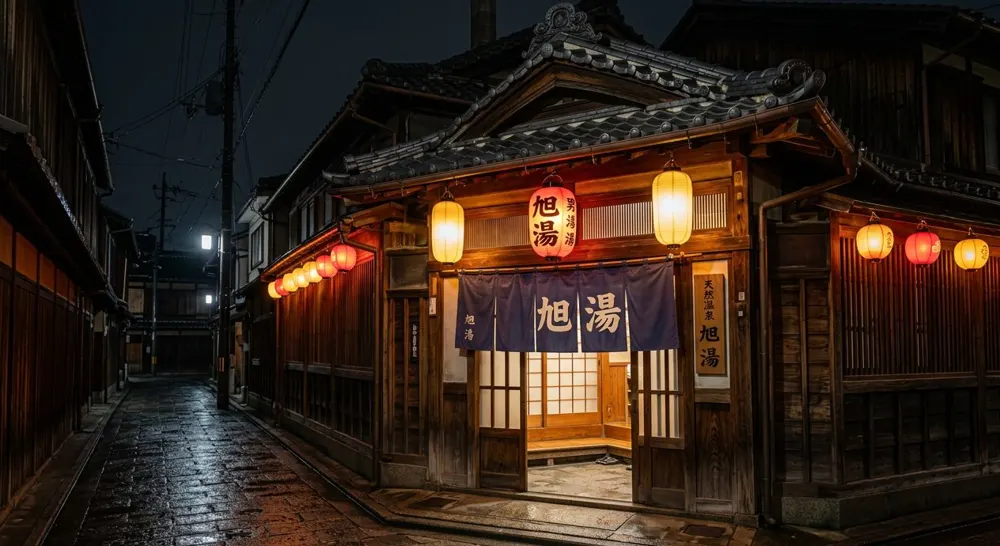
Otakinoyu
A large day facility where you can try Kusatsu's traditional 'awase-yu' — a row of wooden tubs at rising temperatures, entered in order. Indoor baths, rotenburo, sauna, plus rest and dining areas make it good for half a day. About 10 minutes' walk from the Yubatake, or a short bus ride. Admission ¥1,200 (2026); three-bath pass with Gozanoyu and Sainokawara ¥2,100.
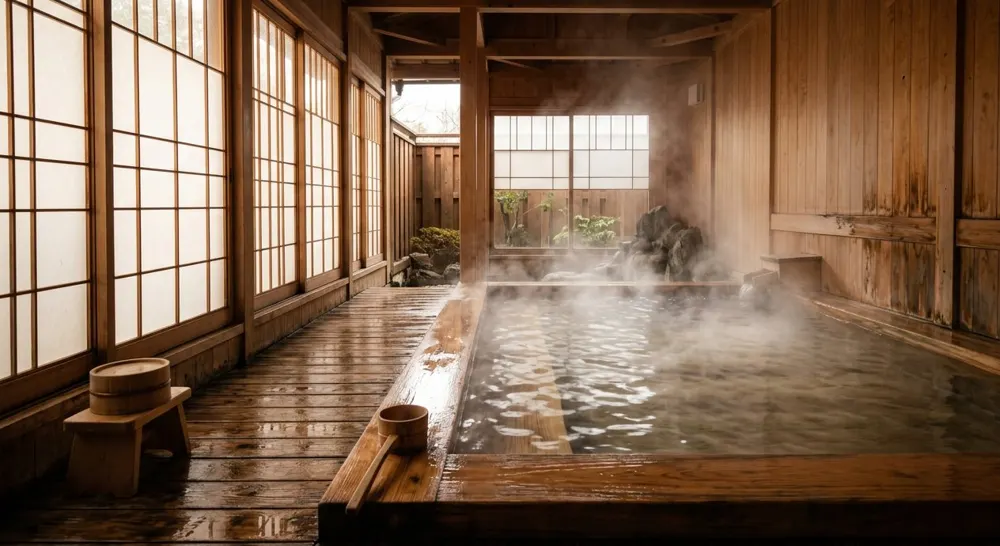
Gozanoyu
Right in front of the Yubatake, a wooden recreation of the Edo–Meiji communal baths. Wood and stone bath halls alternate between men and women daily, with two sources (Yubatake and Bandaiko). The upstairs hall looks down on the Yubatake.
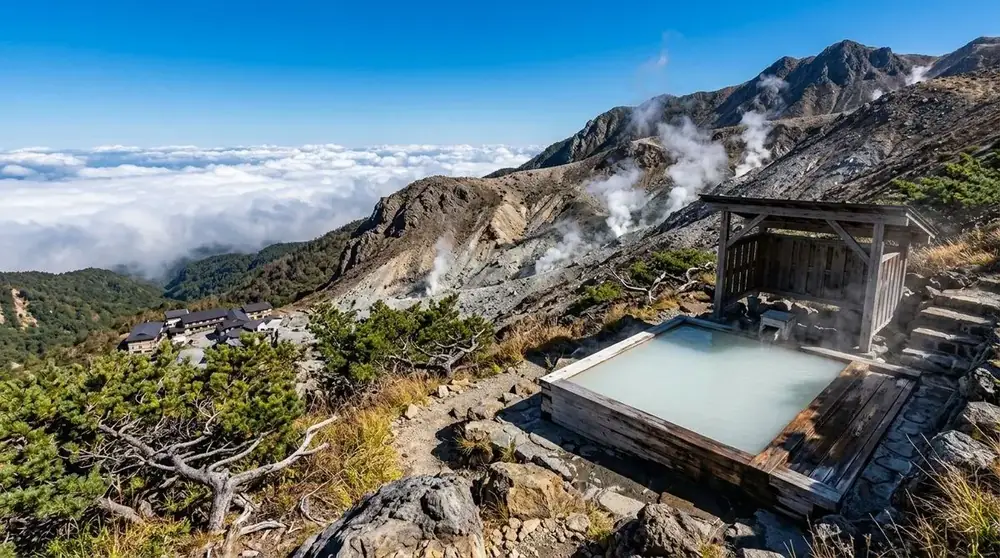
Manza Onsen Nisshinkan
At 1,800 m, one of Japan's highest onsen. Milky water with some of the country's highest sulfur content, across nine tubs. Day use 10:00–17:00; prices rise in peak season.