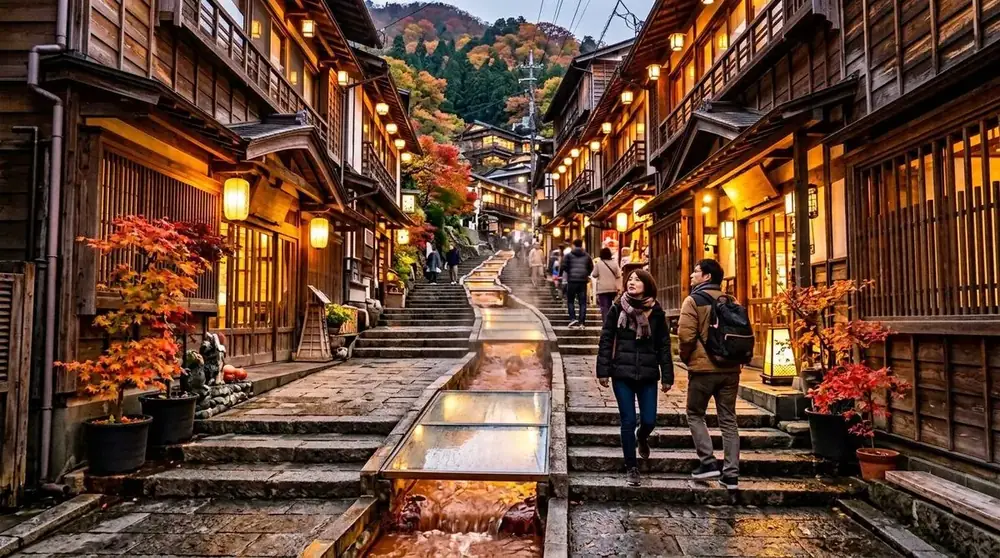
Gunma · Ikaho Onsen
Ikaho Onsen Ishidan-no-Yu
伊香保温泉 石段の湯
A storehouse-style communal bath halfway up the 365-step stone stairway. Iron-rich brown 'golden water' in indoor tubs; rest hall upstairs. Cashless payment accepted.
- Price (adult)
- ¥800
- Hours
- 10:00–20:00(last entry 19:30)
- Closed
- 2nd & 4th Tue (next day if holiday)
- Access
- 25 min by bus from JR Shibukawa to Ishidangai-guchi
- Water type
- Sulfate spring
- Tattoos
- Ask ahead
- Spring type
- 'Kogane-no-yu' (golden water) = calcium-sodium sulphate-bicarbonate-chloride spring. Source 41.2°C, pH 6.4 (neutral), iron(II) 7.2 mg/kg. Clear at source, turning rust-brown on contact with air. Piped about 2 km from the same source as Ikaho Rotenburo; heated, not recirculated
- Price & facilities
- Adults ¥800; children, over-65s and disabled ¥400 (Shibukawa residents ¥500/¥250); infants free. Cards and PayPay accepted. Two-storey storehouse-style building: separate indoor baths with washing stations and showers on the ground floor, a tatami rest hall upstairs. No open-air bath. Shampoo and body wash provided. 10 free parking spaces
- Phone
- 0279-72-4526
- Official site
- www.city.shibukawa.lg.jp/kankou/ikahoonsen/ikahoonsen/p003077.html ↗
- Open in Google Maps
- Google Maps ↗
Essentials
Stay in this onsen town
Compare and book stays in Ikaho Onsen. Day bathing itself needs no booking.
Opens partner booking site (affiliate)
Why go
- In the middle of the stone-step street
- Brown 'golden' water
- Cashless-friendly
The stone steps and the golden water
Ikaho's symbol, the 365-step stone stairway, dates from 1576, when Takeda Katsuyori ordered a planned spa town built to nurse soldiers wounded at the Battle of Nagashino — one of Japan's oldest examples of hot-spring town planning. Beneath the steps the spring still flows through distribution channels called 'komaguchi', visible through glass panels. Ishidan-no-yu is a Shibukawa municipal bath about 94 steps up, its storehouse-style façade blending into the streetscape. It uses the historic 'Kogane-no-yu' (golden water), one of Ikaho's two sources: rich in iron, it emerges clear, oxidises to rust-brown and carries a faint metallic scent. Celebrated in the Man'yōshū anthology and loved by the artist Takehisa Yumeji and the novelist Tokutomi Roka, it warms to the core and has long been prized by women as a 'fertility bath'. There is no open-air pool, but with proper washing stations, showers and an upstairs tatami hall it is the most practical place to try the genuine golden water in the middle of a stroll up the steps.
Practical notes & how it compares with Ikaho Rotenburo
- Shampoo and body wash provided; towels sold (bring your own). Free lockers, hair dryers.
- The water is a mild 40°C or so, good for a long soak. The colour varies day to day and can be almost clear on lighter days.
- Iron stains white towels brown — bring an old one.
- The upstairs tatami hall is free to use; check the notices on bringing in food and drink.
- As a municipal bath there is no explicit tattoo ban, but be considerate.
- Busiest 2–5 pm on weekends and holidays; weekday mornings and after 6 pm are quiet.
- Ten minutes' walk beyond the top of the steps (Ikaho Shrine) is Ikaho Rotenburo at the source itself (¥600, open-air only, no washing stations, closed 1st & 3rd Thursdays), where the golden water is at its strongest. Wash and soak at Ishidan-no-yu, or soak in the concentrated water outdoors at the Rotenburo — connoisseurs do both.
- Near the top of the steps are the free 'Tatsu-no-yu' foot bath and a drinking fountain (the golden water tastes of iron).
Access and surroundings
From Shibukawa Station (JR Jōetsu/Agatsuma lines) the Kan-etsu Kōtsū bus to Ikaho Onsen takes about 25 minutes; alight at the Ikaho Onsen terminal at the foot of the steps or at 'Sekisho-mae', then climb 2–5 minutes. From Tokyo take the Jōetsu Shinkansen to Takasaki and change (about 25 min to Shibukawa), or the 'Jōshū Yumeguri' highway bus from Shinjuku/Ikebukuro, about 2.5 hours. By car it is 20 minutes from Shibukawa-Ikaho IC; with only 10 spaces at the bath, use the paid municipal car parks around the steps. Along the steps are Shōgetsudō, birthplace of the onsen manjū bun, old-style shooting galleries, the Ikaho checkpoint museum, the Takehisa Yumeji Memorial Museum (5 min by car), a ropeway, and Kajika Bridge (15 min walk), famous for illuminated autumn leaves.
Before you go
- No official tattoo policy is published — ask at reception.
- Last entry is 30–60 minutes before closing.
Features
Price
Convenience
Mood & scenery
Amenities
✔ Verified operating: 2026-09 渋川市公式 (大人800円/小人400円, 10:00–20:00 最終入場19:30, 第2・4火曜休, 2024年4月改定)
Prices and hours change. Check official sources before visiting.
More in this area
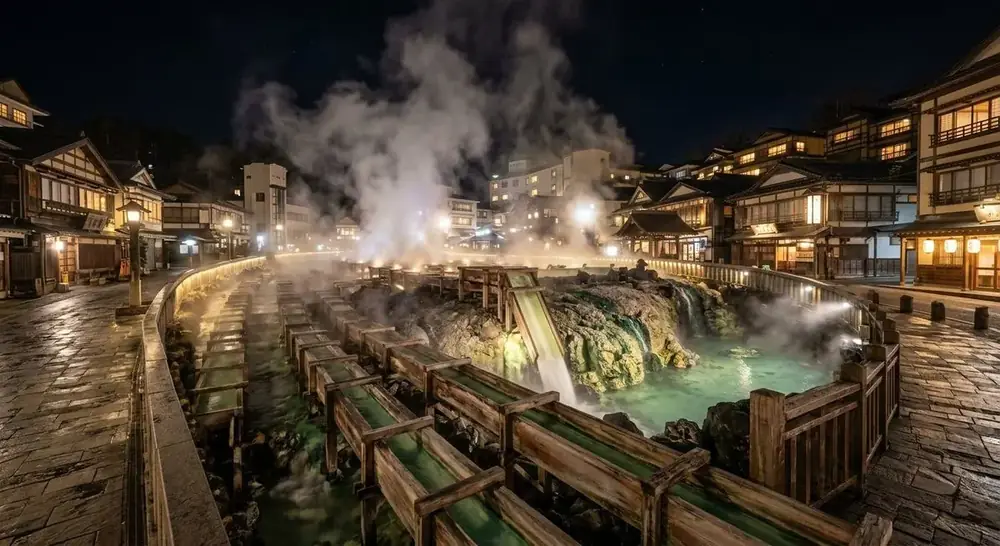
Sainokawara Open-Air Bath
A 10-minute walk west of Kusatsu's Yubatake, at the far end of Sainokawara Park, lies one of Japan's largest open-air baths. Around 500 m² of pool brims with strongly acidic water, open to the surrounding forest. Snow in winter, fresh green in summer, illuminations at night. There are no washing stations — this is purely for soaking.
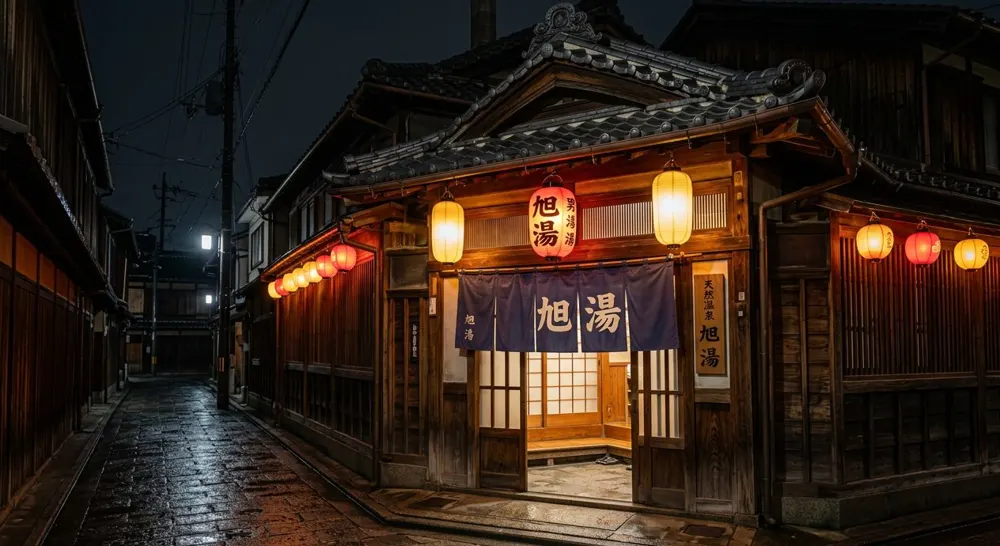
Otakinoyu
A large day facility where you can try Kusatsu's traditional 'awase-yu' — a row of wooden tubs at rising temperatures, entered in order. Indoor baths, rotenburo, sauna, plus rest and dining areas make it good for half a day. About 10 minutes' walk from the Yubatake, or a short bus ride. Admission ¥1,200 (2026); three-bath pass with Gozanoyu and Sainokawara ¥2,100.
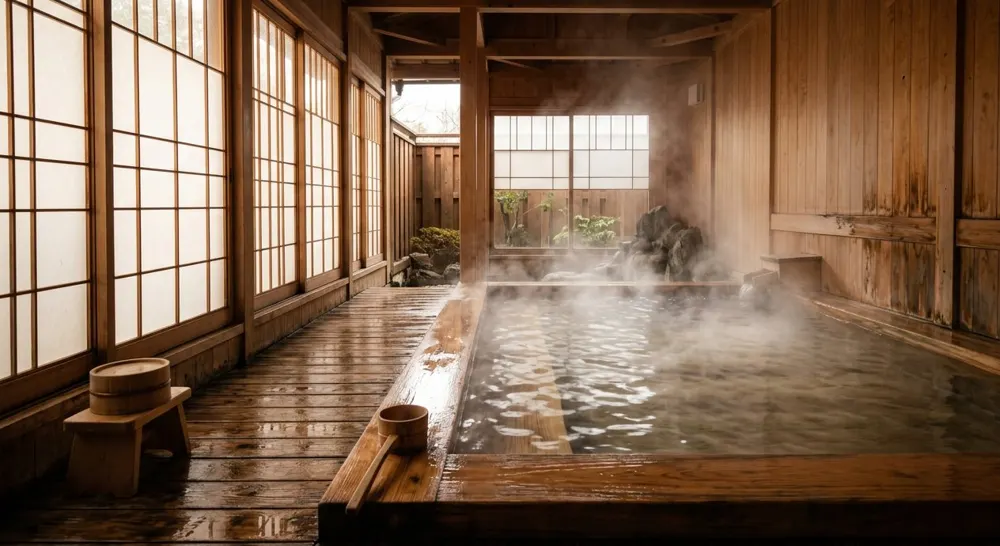
Gozanoyu
Right in front of the Yubatake, a wooden recreation of the Edo–Meiji communal baths. Wood and stone bath halls alternate between men and women daily, with two sources (Yubatake and Bandaiko). The upstairs hall looks down on the Yubatake.