Ehime · Dōgo Onsen
Dogo Onsen Honkan
道後温泉本館
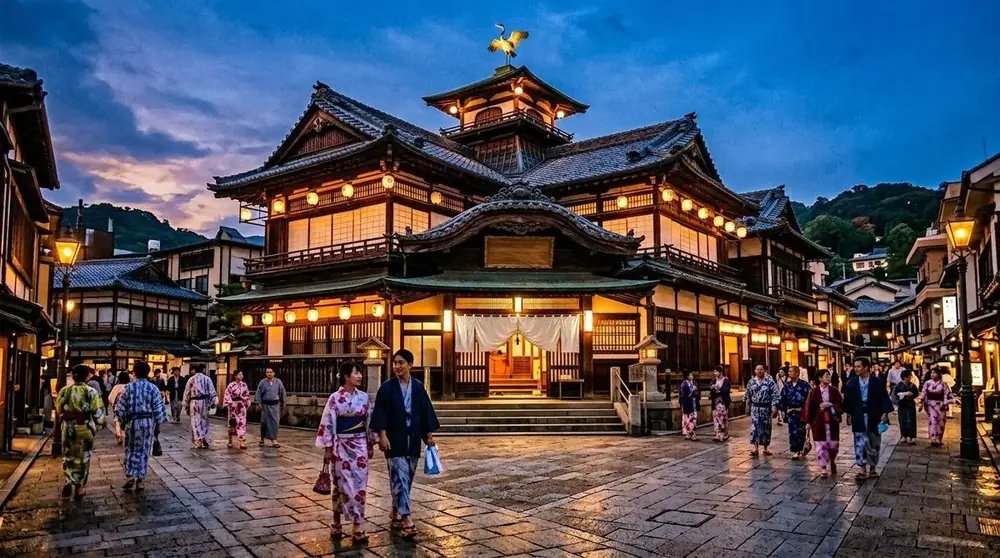
Built in 1894 and the first public bathhouse designated an Important Cultural Property, the Honkan is Dogo's symbol. Full operation resumed in 2024 after a five-and-a-half-year restoration. The ground-floor 'Kami no Yu' is ¥700 for bathing only; upper floors add a rest room with tea. Soft alkaline water. Quietest right after the 6 am opening or after 9 pm.
- Price (adult)
- ¥700
- Hours
- 06:00–23:00 (Kami-no-yu ground floor, last ticket 22:30) / lounges & private rooms 06:00–22:00
- Closed
- Once a year (one closure day in December)
- Access
- 5 min walk from Dogo-Onsen tram stop
- Water type
- Alkaline simple
- Tattoos
- Allowed
- Spring type
- Alkaline simple spring (clear, odourless). Water from 18 sources (20–55°C) is blended to about 42°C with no heating or dilution
- Courses
- Kami-no-yu ground floor ¥700 (child ¥350) / Kami-no-yu 2F lounge ¥1,300 / Tama-no-yu 2F lounge ¥2,000 / Tama-no-yu 3F private room ¥2,500 / reserved rooms: Hisho ¥3,000 per group + ¥1,300 pp, Shirasagi ¥6,000 per group + ¥1,300 pp / Yushinden viewing only ¥500
- Time limit
- 60 min for bath-only and 2F lounges; 90 min for 3F private and reserved rooms
- Phone
- 089-921-5141
- Official site
- dogo.jp/onsen/honkan ↗
- Open in Google Maps
- Google Maps ↗
Essentials
Stay in this onsen town
Compare and book stays in Dōgo Onsen. Day bathing itself needs no booking.
Opens partner booking site (affiliate)
Why go
- Cultural-property bathhouse
- Fully reopened in 2024
- Kami no Yu ¥700
History & architecture
Dōgo is counted among Japan's oldest hot springs, mentioned in the 8th-century Nihon Shoki. The Honkan is a three-storey wooden bathhouse completed in 1894 under Isaniwa Yukiya, first mayor of Dōgo-Yunomachi. In 1994 it became the first public bathhouse designated an Important Cultural Property of Japan; the drum in the rooftop Shinrokaku tower is still beaten at 6 am, noon and 6 pm. Yushinden (1899) is Japan's only bathing suite built exclusively for the Imperial family and can be viewed on a tour. After a five-and-a-half-year conservation project that began in January 2019, the whole building reopened on 11 July 2024. The bathhouse appears in Natsume Sōseki's novel Botchan, and the 'Botchan Room' associated with him survives on the third floor.
Baths and how to choose a course
- Kami-no-yu: the main bath (two rooms for men, one for women), granite tubs with a carved stone spout in the centre. The ¥700 ticket is bath-only with no lounge access, but the water is exactly the same as in Tama-no-yu.
- Tama-no-yu: a smaller, quieter bath. The men's room is lavishly finished in marble and Aji granite; the women's is airier. Tama-no-yu tickets also admit you to Kami-no-yu and include a self-guided look at Yushinden.
- 2F lounge: a 55-tatami hall with yukata, tea and rice crackers. Opening the shutters to cool off after the bath is the classic Dōgo ritual unchanged since the Meiji era.
- 3F private rooms: about 3 tatami each, 90 minutes, with Botchan dango dumplings and tea. Two reservable rooms (Hisho and Shirasagi) run on fixed time slots.
- First visit? The ¥1,300 Kami-no-yu 2F lounge ticket is the best balance of architecture, lounge experience and price.
Facilities, what to bring & etiquette
- The ¥700 ground-floor ticket includes no towel, soap or shampoo (towels are sold at the counter). Lounge tickets include a yukata and tea; Tama-no-yu tickets add towel and bath-towel rental.
- Free key lockers in the changing rooms; hair dryers provided. Expect many steps and steep staircases — accessibility is limited.
- Tattoos are not banned (it is a municipal bath), though signs ask guests to be considerate of others.
- No photography inside the baths; the entrance, drum tower and Yushinden viewing areas are fine.
- No dedicated parking — use the paid Dōgo Onsen car park nearby or your hotel's.
- Busiest 10–12 am and 3–6 pm, especially weekends. Right after opening (6–7 am) or after 9 pm is quietest; the early slot lets you bathe alongside locals.
Getting there
About 5 minutes on foot from Dōgo Onsen tram stop (Iyotetsu) through the covered Haikara-dōri arcade. From JR Matsuyama Station take tram line 5 bound for Dōgo Onsen (about 25 min). Limousine buses run from Matsuyama Airport (about 40 min) and Matsuyama Kankō Port (about 35 min) to Dōgo Onsen Station. The retro 'Botchan Train' also terminates here.
Nearby sights and other Dōgo baths
Dōgo has three public baths on the same spring: the Honkan, the annex Asuka-no-Yu (from ¥610, opened 2017 in Asuka-period style) and the locals' favourite Tsubaki-no-Yu (¥450). In front of the tram stop, Hōjōen has a free foot bath and a mechanical clock that performs on the hour from 8 am to 10 pm; within 10 minutes' walk are Yu Shrine, Isaniwa Shrine (Important Cultural Property) and Dōgo Park on the site of Yuzuki Castle. Since photography inside is prohibited, the illuminated exterior (dusk to around 11 pm) is the classic shot.
Before you go
- As a communal bath there is no soap or shampoo — bring your own or buy at the shop.
- Payment is usually by ticket machine in cash — bring coins.
- Last entry is 30–60 minutes before closing.
Features
Mood & scenery
Price
Convenience
Language support
✔ Verified operating: 2026-09 松山市・道後温泉事務所公式料金表 (神の湯階下700円/二階席1,300円/霊の湯二階席2,000円/三階個室2,500円)
Prices and hours change. Check official sources before visiting.
More in this area
Dogo Onsen Tsubaki-no-Yu
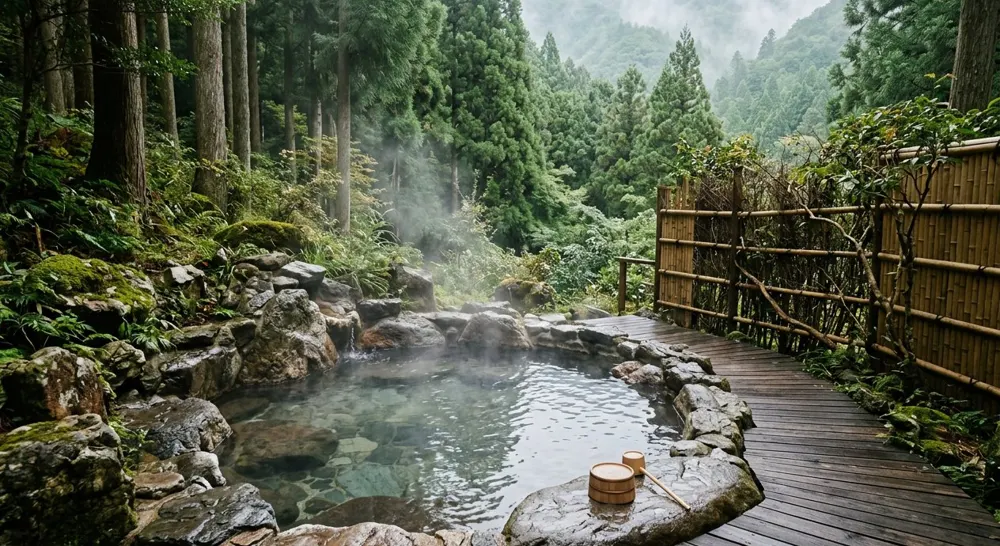
The locals' bath for anyone who wants to skip the Honkan queue. Same source water for ¥500 with almost no wait. Bring or buy soap.
Dogo Onsen Annex Asuka-no-Yu
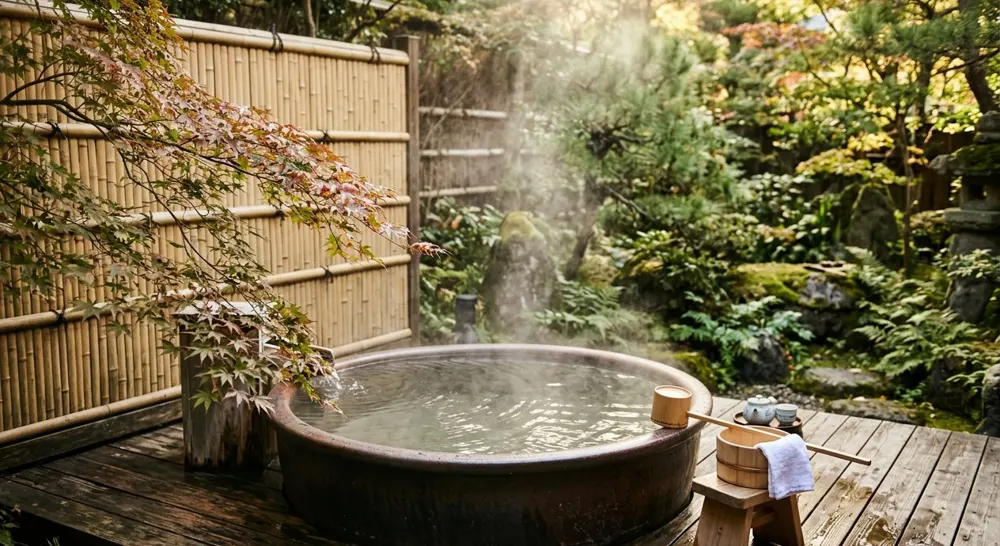
An annex opened in 2017 in Asuka-period style with Ehime craftwork throughout, plus an open-air bath the Honkan lacks. Upstairs rest rooms and a private special bath limited to five groups a day.
Dōgo Onsen Funaya (day use)
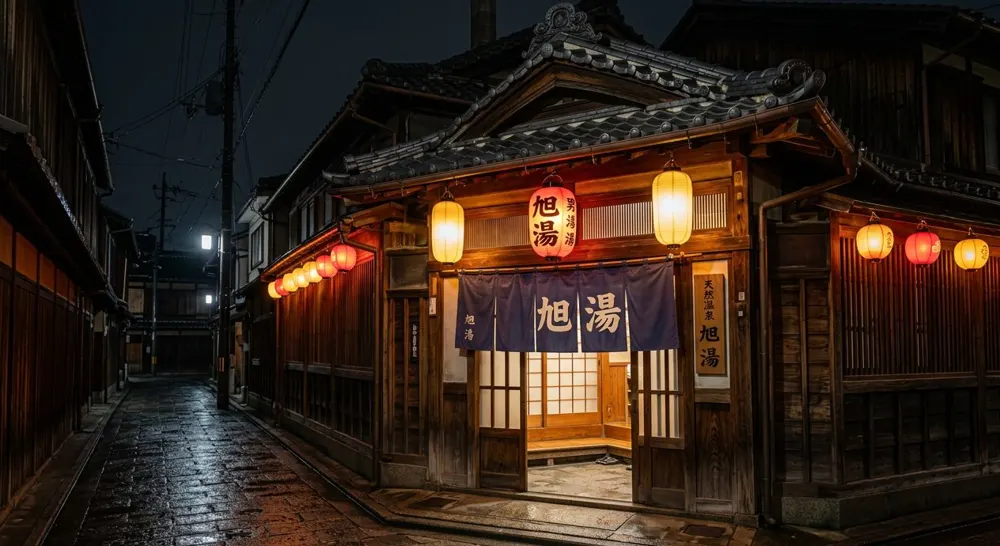
A 390-year-old inn where Sōseki and Shiki once stayed. Two large baths (cypress and granite) with open-air tubs and saunas, all pure Dōgo water. Day use is ¥1,800 with towels and amenities included — a calm alternative to the crowded Honkan.