Kōchi · Ashizuri Onsen (Cape Ashizuri)
Ashizuri Thermae (Ashizuri Onsen)
アシズリテルメ(あしずり温泉郷)
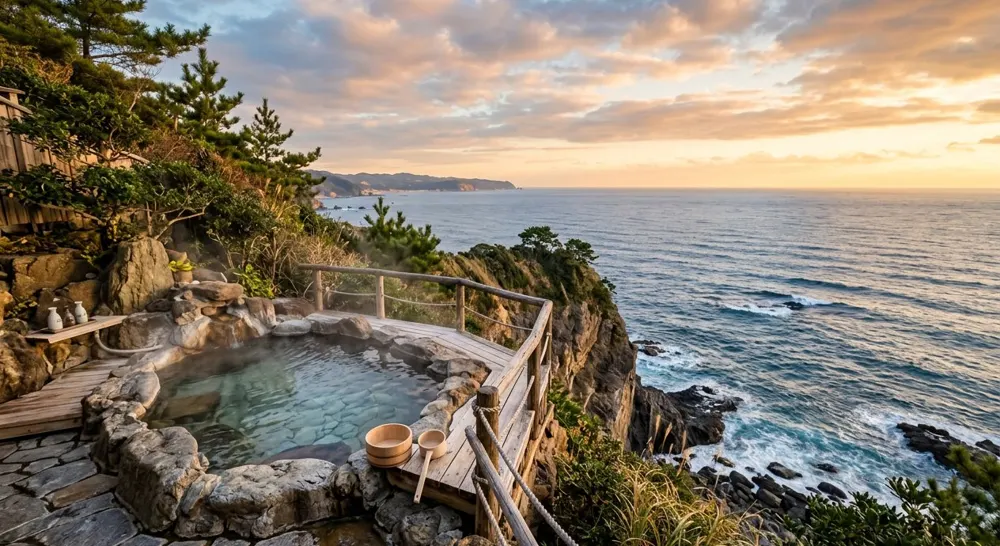
A design hotel on the headland at Cape Ashizuri, Shikoku's southernmost point, renewed in 2024. It holds one of the source wells of the Ashizuri hot-spring cluster — a natural radon spring, mildly alkaline, with a legend linking it to Kōbō Daishi — enjoyed in an open-air bath overlooking the Pacific, two indoor tubs and a Shimanto-cypress sauna. Sunsets into the horizon and the night sky are the draw. Day use 15:00–21:00 (last entry 20:30), ¥1,100 including bathing tax. Closed Tuesday to Thursday (with exceptions in peak season), so confirm ahead. About 90 minutes by bus from Nakamura Station, or an hour by car from Shimanto city. Combine with the cape lookout, the aquarium and the free Manjirō foot bath.
- Price (adult)
- ¥1,100
- Hours
- 15:00–21:00 (last entry 20:30)
- Closed
- Tuesdays & Wednesdays (may open in peak season)
- Access
- About 90 min by Kōchi Seinan bus (for Ashizuri-misaki) from Nakamura Station (Tosa Kuroshio Railway), then 10 min on foot; about 60 min by car from Shimanto city
- Water type
- Radon spring
- Tattoos
- Ask ahead
- Admission
- Day bathing adults ¥1,100, elementary ¥500 (some sources: preschoolers free). Towel rental paid (set about ¥300), shampoo and amenities provided. Free for overnight guests. Baths and rest lounge refreshed in a 2024 renewal. Panoramic restaurant (dinner mainly for guests), shop with bonito and yuzu products. Day bathing starts at 15:00, so an evening soak after sightseeing at the cape is the norm
- Baths
- A resort hotel of the 'Ashizuri Onsen-kyo' spa area (one of the former Ashizuri Kokusai Hotel group, renewed in 2024) on high ground overlooking the Pacific, five minutes by car from the lighthouse and Kongofuku-ji temple at Cape Ashizuri, Shikoku's southernmost point. From the glass-walled main bath and rotenburo: the horizon, the deep blue of the Kuroshio current, sunrise and moonlit sea. A radon-bearing cold mineral spring, heated. The cape is one of Japan's finest stargazing sites (Ashizuri Space Hall), with the camellia tunnel, Hakusan sea cave and Tatsukushi marine park nearby. Local food: Shimizu mackerel, seared bonito and Kuroshio seafood
- Spring water
- Ashizuri Onsen-kyo, a simple cold mineral spring containing radon (a source in the 20s °C, heated; check on-site notices for the full analysis), recirculated and disinfected. Colourless, odourless and mild; radon waters, absorbed through breath and skin, are known as a 'cure-all' said to aid metabolism. Indicated for neuralgia, rheumatism, gout, high blood pressure and fatigue. A resting bath for 'ohenro' pilgrims visiting Kongofuku-ji, No. 38 of the Shikoku 88 temples
- Access & parking
- 1 h by car (about 45 km) from Nakamura Station on the Tosa Kuroshio Railway; Kochi Seinan Kotsu bus Nakamura Station to Cape Ashizuri 1 h 50 min, alight at 'Ashizuri Onsen-kyo' then 3 min on foot (a few a day). Enquire about guest pick-up. By car about 3 h from Kochi city, 1 h from Shimanto city. Free parking. Cape Ashizuri lighthouse 5 min, Tatsukushi 30 min by car
- Phone
- 0880-88-0301
- Official site
- ashizurithermae.jp ↗
- Open in Google Maps
- Google Maps ↗
Essentials
Find a stay on Trip.com
Search and book accommodation across Japan on Trip.com. Day-use bathing needs no booking.
Opens partner booking site (affiliate)
Why go
- Southernmost Shikoku; Pacific sunset from the bath
- Renewed 2024; natural radon spring
- 15:00–21:00, ¥1,100; closed Tue–Thu
At Shikoku's southern tip: a cape bath over the Kuroshio sea and starry sky
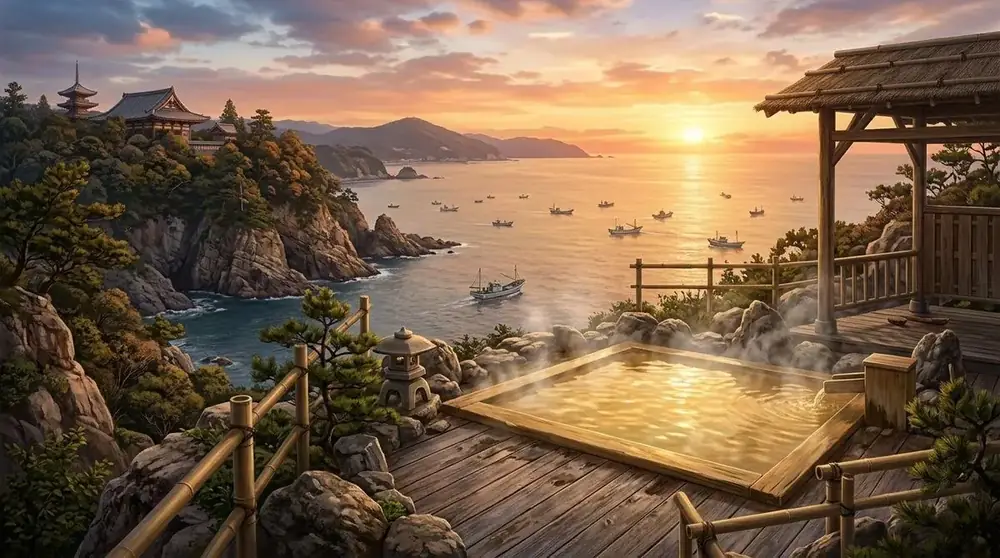
Ashizuri Thermae is a resort hotel of the 'Ashizuri Onsen-kyo' spa area on high ground overlooking the Pacific in Tosashimizu, Kochi, five minutes by car from the lighthouse at Cape Ashizuri, the southernmost point of Shikoku. The cape is land's end: a white lighthouse on 80-metre cliffs, pilgrims gathering at Kongofuku-ji, No. 38 of the Shikoku 88 temples, a sea of deep indigo where the Kuroshio current runs closest to shore, and at night one of Japan's finest starry skies. The hotel's glass-walled main bath and rotenburo, renewed in 2024, face that sea head-on, so you can soak in the soft radon-bearing water and watch the curve of the horizon, the sunrise, or moonlight on the water. Day bathing is 15:00 to 21:00 at ¥1,100 for adults — the natural rhythm is to walk the cape paths, the camellia tunnel, the Hakusan sea cave and the Tatsukushi marine park, then drop in for an evening soak. At three hours by car from Kochi city and an hour even from Nakamura Station it is 'Shikoku's most remote onsen', but a view worth the journey waits in the bath. Closed Tuesdays and Wednesdays, though it may open in peak season — check ahead.
Horizon from the glass-walled bath and rotenburo, stars at night
Ask for day bathing at the front desk by the entrance, pay ¥1,100 and you will be shown to the baths. The 2024 renewal left the changing room and wash stations bright and clean, with amenities provided. The main bath's entire seaward wall is glass, so once in the water the Pacific fills your view, the Kuroshio's deep indigo layered against the blue of the sky. The water is a radon-bearing cold mineral spring, heated — clear, odourless and gentle, good for long soaks — and as radon springs do, it warms you to the core so the heat lingers long after you climb out. The rotenburo is not large, but the wind carries the sound of waves; at dusk the western sky reddens (the same direction as the cape's sunset spot), and once fully dark the starry sky Cape Ashizuri is famous for spreads overhead, with the Milky Way visible on clear nights. Since day bathing starts at 15:00 you are in the evening slot anyway: in winter aim for sunset around 17:00 then stars after 18:00, in summer sunset at 19:00 then stars at 20:00, entering before the 20:30 last entry. Afterwards rest in the lobby lounge facing the sea and pick up Tosashimizu's 'Shimizu saba' mackerel and bonito products or yuzu sweets in the shop. The hotel restaurant mainly serves overnight guests, so day visitors do better to stop at a seared-bonito or Shimizu-saba eatery in Tosashimizu town (20 minutes by car) before bathing.
Practical details and an Ashizuri–Shimanto route
Day bathing is 15:00–21:00 (last entry 20:30); closed Tuesdays and Wednesdays (it may open in busy periods such as Golden Week, summer and New Year, and conversely may suspend day bathing when groups are staying, so a phone call is advised); adults ¥1,100, elementary ¥500. Access is an hour by car from Nakamura Station on the Tosa Kuroshio Railway or 1 h 50 min by Kochi Seinan Kotsu bus (a few a day), three hours by car from Kochi city, parking free. A rental car is the realistic option; roads around the cape have narrow stretches, so take care driving at night. A suggested two days: Day 1 Kochi, three hours' drive to the Tatsukushi marine park and Minokoshi coast (glass-bottom boat), a Shimizu-saba lunch in Tosashimizu, walks to the Cape Ashizuri lighthouse, Kongofuku-ji, the camellia tunnel and Hakusan sea cave, a sunset-and-stars bath at Ashizuri Thermae, overnight at the cape; Day 2 a drive and canoe along the Shimanto River's submersible bridges (Sada and Iwama), then Nakamura and back to Kochi. February–March brings the cape's 60,000 wild camellias into bloom, summer offers diving and whale watching, and autumn to winter the clear air is ideal for stargazing, with viewing sessions at the Ashizuri Space Hall. For those on the Shikoku 88-temple pilgrimage it is the ideal rest on the long stretch between No. 38 Kongofuku-ji and No. 39 Enko-ji. Radon springs have no distinctive smell and are gentle, so they suit onsen beginners and children too.
Before you go
- No official tattoo policy is published — ask at reception.
- Ryokan day-use hours are limited and may be suspended in peak season — phone the same morning.
- Last entry is 30–60 minutes before closing.
Features
Sauna & wellness
Mood & scenery
Price
Who with
Amenities
✔ Verified operating: 2026-09 Operating status and rates cross-checked against the official site and onsen guides (full source notes in Japanese on the JA page)
Prices and hours change. Check official sources before visiting.
More in this area

Sansuien Suisaikaku Onsen
The bath wing of a historic hotel built on the site of the Yamauchi lords' residence below Kochi Castle. A rare natural hot spring in central Kochi, with a rotenburo facing the Kagami River and Mt. Hitsuzan, a large indoor bath and sauna. Day use is daytime only, 10:00–16:00. Fifteen minutes on foot from Harimaya Bridge — easy between sightseeing and the Sunday market. ¥1,200; bring or rent a towel.

Tosaryu Onsen Sanyoso
Forty minutes by car from Kochi city, a hot-spring inn beside Shoryuji, temple 36 of the Shikoku pilgrimage. It claims Kochi's only high-concentration, high-temperature spring; the golden chloride water is nicknamed 'the heat bath' for how long it keeps you warm. The rotenburo looks over Usa Bay and the Pacific, and there's a free seaside footbath. Day use in two sessions — 5:30–9:00 and 14:00–21:00 — ¥750 on weekdays.

Hotel Matsubakawa Onsen (Shimanto)
A solitary inn on the Hinoji River in the Shimanto headwaters. Its viscous, highly alkaline water has been revered as a healing spring since the Edo period, and a day soak is a modest ¥700. Enjoy the open-air bath above the stream or book a private bath. Open late, 10:30–21:00, and 30 minutes by car from Kubokawa Station—ideal after canoeing or cycling the Shimanto.